In this category, it's not the top that gives a piece its look, it's what's underneath. Look at the base before the colour: a single leg, a steel frame or two interlocking triangles give you three completely different living rooms with the same surface on top. Six pieces stand out on this reasoning, alongside the fuller best design coffee table round-up.
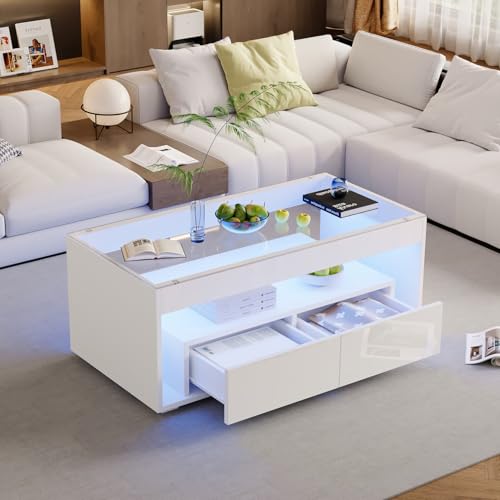
A hundred by fifty centimetres, white lacquer and a glass top, with light strips you control from your phone. The top stops at 40 cm: keep it for a deep, low seat, or you'll lean forward for every glass. Two sliding drawers absorb everyday clutter. Check for a nearby socket — the lighting needs plugging in.
IDMarket, Table Basse Alicia Plateau Bois et Pied X Blanc
100 x 60 x 45 · White, Wood
A wood-effect top with raised edges, on a white central X-shaped base that clears the floor. Its 60 cm of depth is among the most generous on this page: a full board game fits without spilling over. The 45 cm height is the maximum recommended for a coffee table, so at the right level for serving. Those raised edges, though, make wiping harder.
119 cm long, the largest top gathered here, and just 39.8 cm tall: a stretched-out, very low-slung line, in black wood-grain melamine. Check your cushion's height before ordering, since under a tall seat your torso will work for every glass. Melamine takes scratches better than varnish, but the black shows everything.
FATIVO Table Basse Marbre de Salon: Table Café Industrielle Rectangula
100x60x43 cm · White
White sintered stone on a matt black steel frame: the whole design rests on that contrast. This material ignores the heat of a cup and grease marks, where natural stone soaks up coloured liquids. 100 by 60 format, 43 cm tall. Choose its spot once and for all: the top is heavy, you won't be moving it again.
GOLDFAN Lot de 2 Table Gigognes Triangulaire pour Salon
grande table:100*50*43cm/petite table:70*35*40cm · Brown
Two triangles with softened corners that slide one under the other, 100 by 50 for the large one, 70 by 35 for the second. The rounded edges limit knocks at child height. Separate them to frame the sofa, bring them together to free up the middle of the room. The light finishes on beech legs mark quickly: keep coasters handy.
BTM Table Basse De Salon Noire Réglable en Hauteur 50×100×46Cm
50X100X46CM · Blackled50
A metre long, glossy black, an openwork frame and built-in light strip. The top rises above its starting height of 46 cm, enough to set down a quick meal or a keyboard in front of you. Removable side panels and a discreet compartment under the panel. Know what you're signing up for: glossy black shows dust more than any other finish.
As an Amazon Associate, we earn from qualifying purchases. The product links on this page may earn us a commission if you buy something — at no extra cost to you. Prices shown may have changed since we last checked.
Price alert
Tell me when the price drops
We watch the tables on this page for you. One email when one of them drops, nothing else.
The Base Writes the Style
In front of a living-room photo, cover the top with your thumb: what's left visible is almost always enough to date and place the piece. The base carries the style, the top is just a surface. That test gets even clearer in an open space where nothing hides the legs, which is why we look closely at a coffee table for a loft.
The single leg, central, X-shaped or column-shaped, produces an object that seems to float with nothing holding it. It clears the floor, so it lightens an already busy room, and it lets you sit close by without bumping into an upright. Its weakness is mechanical: everything rests on one base, whose width needs to reach roughly half the top's size to rule out tipping. Compare those two measurements in the listing before confirming.
The slim metal frame, usually matt black, draws a clean line around the volume. It carries heavy tops, suits industrial-inspired interiors, and survives vacuum knocks far better than a panel edge. One thing to check: a pad under each tube. Without one, your floor scratches the first time you move it.
Multiple volumes turn the piece into a composition: two nested triangles, a set of tops at staggered heights. You get a lively design and, above all, a geometry you can change — tight during the week, spread out on evenings you have guests. It's the only family that changes silhouette without you buying anything new. Its downside: two pieces, so twice the surface to wipe.
One tip that will save you a mistake: the more visible the base, the more it needs to answer another metal already in the room — a floor lamp, handles, sofa legs. An isolated matt black amid light woods catches the eye for the wrong reasons. Walk round your living room and count your metals first.
The Materials That Make the Look, and What They Ask of You
Four surfaces share this category, and they won't ask the same upkeep of you. If it's the base doing the deciding between modern and industrial, our modern or industrial comparison weighs both bases directly. If Japandi is the exact look you're after, our Japandi style guide narrows the base choice further still. Furnishing a new flat from scratch? Our new flat guide covers bases suited to a first, blank-slate living room. A concrete floor changes which base actually works, as detailed in our guide to concrete floors. For the closer call between two Nordic-rooted looks, our Scandinavian or vintage comparison spells out the difference. Choose first based on what you're willing to wipe.
Sintered stone comes out on top for peace of mind. Fired at very high temperature, it has almost no porosity: a hot cup, a drop of oil or a spilt glass of wine wipe away without leaving a shadow. That's what sets it apart from natural stone, stunning but thirsty for coloured liquids once the treatment wears off. Its downside is bulk: no rearranging the living room on a Sunday evening.
Melamine copies wood or lacquer with less effort. On an 18 mm panel, it holds up well to everyday wear and cleans with a wipe of a sponge. Its weak point stays the edge, a strip glued round the rim that comes loose if water sits at the corner. Get into the habit of drying these edges, that's where ageing starts.
Glass brings transparency and an immediate sense of space in a busy room. It records every fingerprint, prepare for that. And check its thickness in the listing: below eight millimetres, don't set heavy objects on it.
Glossy lacquer, white or black, gives the most striking effect in photos and the most demanding one at home. It bounces light, so it shows dust, fingerprints and the faintest circular micro-scratch. A lightly damp microfibre cloth, never powder or a scouring sponge: on lacquer, a scratch can't be undone. If no one will wipe it down every couple of days at your place, choose a different finish.
Built-In Lighting and Extras: What to Check Beforehand
Several pieces in this category now come with an LED strip, controlled by remote or app. For a country house specifically, our country house guide covers sturdier bases built for heavier everyday use. For a workshop-style room specifically, our industrial workshop style guide leans harder into exposed, factory-style bases. Torn between an aged look and a raw one? Our vintage or rustic comparison settles that exact question. For a look at where these bases and shapes are heading next, see our 2026 coffee table guide. Raw metal against aged wood, our industrial or vintage comparison covers that specific pairing. The effect works in the evening, provided you plan for three things before ordering.
First, power. These strips plug into the mains, often through a small transformer. So you need a reachable socket right where the piece will sit, and a cable crossing the living room always shows more than you'd expect on a light-coloured floor. Find the socket before the spot, not the other way round.
Then, control. An app depends on a charged phone, a connection, and sometimes an account to set up; a remote depends on a battery and gets lost under the sofa. Neither is more reliable than the other, but one will suit your household better. Above all, check the light can be turned off simply, for the day you no longer want it.
Finally, lifespan. An LED strip isn't replaced like a bulb: it's often glued into a groove, sometimes soldered. The day a section goes dark, you live with it or you take it apart. Nothing fatal, but treat this lighting as a nice extra, never as the main reason for your purchase.
Two other options are worth a look in the spec sheet: removable dividers inside a compartment, which stop everything rolling to the back, and height adjustment where it exists, which noticeably widens what the same piece can do.
You can also enter through colour: white to brighten a dark room, black to set an anchor point, beige to calm an already busy living room. Or through function, with lift-top tables for eating in front of the television without hunching over and storage pieces for tidying clutter in one motion. Or through shape, with round tops when the walkway around the sofa is measured in centimetres. If budget ends up making the decision, open the affordable models page and come back after.
Worth knowing
Frequently asked questions
What sets a design coffee table apart from another?
Mostly the work done underneath. A central leg, an exposed steel frame or interlocking volumes create a recognisable silhouette, where an ordinary piece has four plain uprights. So look at the structure in side-view photos: that's what signs the piece.
Is sintered stone the same as marble?
No. It's mineral powders pressed then fired at very high temperature, giving an almost non-porous surface. The veining copies natural stone, but in use it takes heat and coloured liquids far more easily. Its downside is the bulk.
Is built-in lighting complicated to install?
No, but you need a socket within reach of the piece: these strips plug into the mains, with a transformer. The real issue is the cable's path across the room. Find the socket before settling on the spot, or a cable will cross your rug.
Does a glossy finish scratch quickly?
It doesn't scratch more than any other finish, it shows everything. Reflected light reveals dust, fingerprints and the circular micro-scratches left by a cloth. Use a barely damp microfibre cloth and rule out scouring sponges and powders for good: on lacquer, once it's scratched, it stays scratched.
How do you match it to a sofa you already have?
Start from the visible metal in the room rather than the wood. A matt black base works if it echoes a floor lamp or legs in the same tone elsewhere. Then measure your seat cushion and check the tabletop height stays close to it.
Written by the Tavolia Bassio team
We don't test the furniture: we record each piece's measurements one by one and say where our figures come from. When a dimension is missing from a listing, we say so instead of guessing. Our method.
 BTM Table Basse De Salon Noire Réglabl
 IDMarket, Table Basse Alicia Plateau B
 EURHCIO Table Basse Salon Blanche 50x1
 Hanah Home Élégante Table à café Noire
 GOLDFAN Lot de 2 Table Gigognes Triang
 FATIVO Table Basse Marbre de Salon: Ta