HomeStyleModern or Scandinavian: Which Coffee Table Should You Choose?
Style
Modern or Scandinavian: Which Coffee Table Should You Choose?
Scandinavian style relies on light wood and open shapes, designed not to weigh a room down. Modern goes further into simplicity, sometimes almost erasing the frame in favour of an almost floating top. The two styles often overlap on recent models, to the point that a single table sometimes sits between both labels. What really sets them apart is the storage on offer: a sliding door, an open tier or a bare top. Four tables to compare on that point rather than on a style boundary that's blurry anyway. Shoppers comparing formats often check a which coffee table for an industrial living room too. A which coffee table for a scandinavian living room solves this differently, and it's worth comparing. See how a modern coffee table stacks up if this isn't quite right for you. The same logic applies when picking a scandinavian coffee table. It's worth comparing this against a vintage or design coffee table before deciding. Whichever style wins out, our design coffee table selection gathers every standout piece in one place.
Which one to choose, based on your living room
If budget is the deciding factor
IDMarket, Table Basse Ovale Marthe 110 cm Bois façon hêtre
IDMarket, Table Basse Ovale Marthe 110 cm Bois façon hêtre
110 x 60 x 45 · Wood Light
IDMarket offers an oval shape in beech-effect wood, a choice that softens the lines compared with a classic rectangular top. Allow 110 cm at its widest, 60 cm across and 45 cm off the floor. It keeps a modern look despite the wood material, with a finish the manufacturer itself calls loft-style. It suits a living room where you want to avoid sharp corners around the sofa. Its limit: an oval shape of this length needs a bit more floor clearance than a rectangle of equivalent surface area.
[en.casa] Table Basse avec Portes Coulissantes et Compartiments de Ran
120 x 55 x 40 cm · Natural
[en.casa] hides storage compartments behind sliding doors, topped off with an open central shelf. The top measures 120 in length by 55 cm in width. This mix of closed and open storage suits anyone who wants to hide some items while keeping others within reach. Standing 40 cm tall, it stays low and unobtrusive. The downside: sliding doors take one more step than a plain top, a detail that matters in daily use.
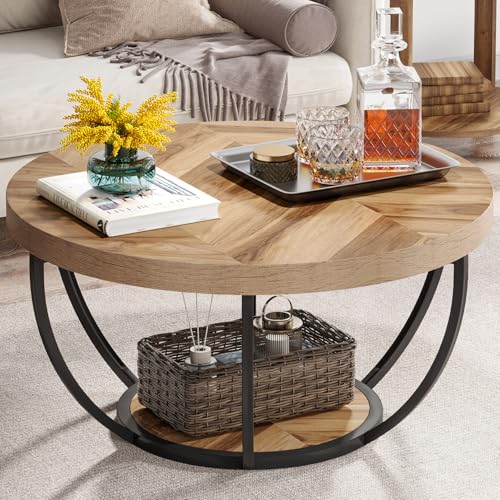
Tribesigns Table basse ronde de cocktail industrielle moderne à 2 nive
80 x 80 x 45 cm · grain de Wood+black
Tribesigns builds a round two-tier table that borrows as much from industrial as from modern style, with shelves that multiply drop surfaces. Allow 80 by 80 cm on the floor, and 45 cm in total height, suited to a fairly low sofa. The manufacturer emphasises the quality of the materials and attention to finish. Its limit: the round two-tier shape takes up more visual volume than a simple top, a point worth considering in a small room.
Anmas Power uses a denser-than-average tabletop board, designed to resist knocks and everyday wear, at 100 cm long by 40 cm deep. The double wooden layer with a shelf adds a storage tier beneath the main top. Standing 40 cm tall, it works just as well as an occasional desk as a classic coffee table. On the other hand, this desk-and-coffee-table dual function means a height that doesn't suit every very low sofa.
The line between modern and Scandinavian is blurring
Many current tables borrow light wood from Scandinavian style and clean lines from modern style, to the point that it's hard to file a given model under just one label. When the modern and Scandinavian lines start to blur, the retro-look tops give a clearer point of contrast. Where labels blur, comparing two sharper opposites helps, which is exactly what the industrial or vintage coffee table page does.
That blurring isn't a problem in itself: it lets you choose on more reliable criteria than a style label, such as the storage on offer or the shape of the top.
Rather than searching for THE Scandinavian table or THE modern table, it's better to list what you actually need day to day, then compare the models that meet it.
Key point Rather than searching for THE Scandinavian table or THE modern table, it's better to list what you actually need day to day, then compare the models that meet it.
Sliding doors versus an open shelf
A sliding door fully hides its contents, a real advantage in a living room that often has guests and where you'd rather not put everyday clutter on show.
An open shelf, by contrast, keeps items reachable in one motion, with no extra handling, which suits more frequent use like a remote or a book you're currently reading.
The choice between the two depends less on the displayed style than on how often you access what's stored in the table.
Key point The choice between the two depends less on the displayed style than on how often you access what's stored in the table.
An oval or round shape in a small living room
An oval or round table avoids sharp corners, a real advantage in a narrow passageway or a room where people move around the sofa often without paying much attention.
It does, however, take up more floor clearance than a rectangle of the same length, since its widest point sits in the middle rather than spread along the whole length.
In a spacious room, this difference barely shows; in a studio flat, it can be the difference between a table that fits and one that gets in the way.
Key point In a spacious room, this difference barely shows; in a studio flat, it can be the difference between a table that fits and one that gets in the way.
Dual desk and coffee table function
A table that also works as an occasional desk suits a home where there's no room for a separate proper workspace, provided you accept a slightly greater height than a classic coffee table.
That intermediate height doesn't suit a very low sofa, where the gap becomes uncomfortable for sitting and resting your feet.
Save this type of model for a living room that genuinely needs to combine uses, rather than a space that already has a dedicated desk elsewhere.
Key point Save this type of model for a living room that genuinely needs to combine uses, rather than a space that already has a dedicated desk elsewhere.
Measure before choosing
The point to check before anything else: the height of your sofa's seat cushion, often close to 45 cm, which the top shouldn't exceed.
A round or oval shape sometimes overhangs more than expected on the sides: measure generously before confirming the spot, especially if the surrounding passage space is already tight.
For length, aim generous without exceeding your sofa: a table that overhangs on both sides disrupts the room's visual balance more than it serves it.
Key point For length, aim generous without exceeding your sofa: a table that overhangs on both sides disrupts the room's visual balance more than it serves it.
A studio flat or a large living room: the same model doesn't always suit both
In a studio flat, every piece of furniture needs to stay visually light: a round or oval shape, on slim legs, fits better than a bulky two-tier top.
In a large living room with a three-seater sofa, too compact a model looks lost and doesn't give the space around it any structure.
So adjust the table's size to the room first, even before choosing between modern and Scandinavian.
A studio flat also benefits from models that combine several uses: a table that works as a desk by day and becomes a coffee table again in the evening saves a whole piece of furniture. In a large living room, that dual function matters less, since space generally isn't the constraint.
Key point In a large living room, that dual function matters less, since space generally isn't the constraint.
Worth knowing
Frequently asked questions
How do I tell whether a table is more modern or Scandinavian?
In practice, the line is often blurry on recent models. Go by the storage and shape rather than the style label. That's what really determines everyday use.
Do sliding doors wear out over time?
A reasonably good mechanism stays reliable for several years without particular issues. Repeated rough handling wears the runners faster. Simple upkeep is enough to extend its life.
Does a round table suit a busy passageway?
Yes, its rounded corners limit accidental knocks when moving around. It's a good choice in a slightly narrow passage. It just needs a bit more floor clearance.
Can I use a coffee table as a desk every day?
It's possible for occasional or light use, but the height stays less comfortable than a real desk over time. For heavy daily use, a dedicated desk remains preferable. As a stopgap, the dual function does the job well.
Does light Scandinavian wood get dirty faster?
Marks show a little more than on dark wood, without the material being any more fragile because of it. Regular wiping with a cloth is enough to keep a good look. Nothing that justifies ruling it out.
Is an open central shelf practical day to day?
Yes, it lets you keep frequently used items within reach, like remotes or a book. It does leave what's on it permanently on show, though. It comes down to your tolerance for visible items.
Which table should I choose for a small studio flat?
Favour a compact model with simple lines, ideally round or oval to limit corners. Avoid two-tier structures, which take up more visual volume. The goal is to keep a sense of space.
Does the dual desk-coffee-table function suit every sofa?
No, it needs a fairly high sofa seat to stay comfortable once the table is used as a desk. With a very low sofa, the gap becomes awkward. Check this height before ordering.
Price alert
Tell me when the price drops
We watch the tables on this page for you. One email when one of them drops, nothing else.
As an Amazon Associate, we earn from qualifying purchases. The product links on this page may earn us a commission if you buy something — at no extra cost to you. Prices shown may have changed since we last checked.
Written by the Tavolia Bassio team
We don't test the furniture: we record each piece's measurements one by one and say where our figures come from. When a dimension is missing from a listing, we say so instead of guessing. Our method.

![[en.casa] Table Basse avec Portes Coulissantes et Compartiments de Rangement Table d'Appoint Massif Intemporel](https://m.media-amazon.com/images/I/51ACvH3rOXL._SL160_.jpg)

 Anmas Power Table Basse Ovale Moderne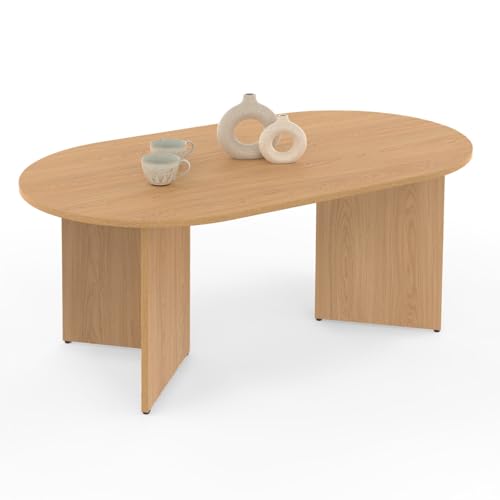
![[en.casa] Table Basse avec Portes Coulissantes et Compartiments de Rangement Table d'Appoint Massif Intemporel](https://m.media-amazon.com/images/I/51ACvH3rOXL._SL500_.jpg)