Run your tape measure across the free space in front of the sofa: on a top with no corners, diameter decides before every other measurement. It sets the usable surface, the reach your arm needs to grab a glass, and what's left to walk around it. Once you've got that number, the choice narrows to six, or to the fuller best round coffee table round-up if you want more options.
Which one to choose, based on your living room
If budget is the deciding factor
IDMarket, Table Basse Ronde Alix Pied araignée 70 cm Bois et Blanc
Sixty centimetres across, four beech legs, in an olive green that stands out from the usual wood tones. The top sits at 47.5 cm: just above a standard sofa seat, so you can set a plate down without reaching downward. Pick it for a two-seater or the corner of an armchair; anywhere else, this small diameter disappears.
IDMarket, Table Basse Ronde Alix Pied araignée 70 cm Bois et Blanc
70 cm x 70 cm x 40.5 cm · Brown And White
70 cm across and set at just 40.5 cm, so genuinely low: check the height of your armrests, it slides under most sofas. The white metal spider base leaves the floor completely clear, so you clean underneath in one sweep. The trade-off of this single-column base: it tips if you lean on the very edge of the top.
80 cm, the largest diameter on this page, in tempered glass kept low, at 42 cm off the floor. Glass doesn't block the eye: in a narrow room, it makes the piece disappear rather than adding visual weight. Buy the microfibre cloth at the same time — fingerprints show up immediately and wiping becomes a daily habit.
Two tops that nest, 70 cm and 50 cm, carried on black metal legs. The sintered stone copies the look of marble without its porosity: you wipe it, nothing stays. You pull the small one out when guests arrive, then tuck it back underneath afterwards. Its limit: two tops at two heights will never make one large continuous surface.
A 100-by-50 oval, the longest top in this selection, closed off by sliding rattan doors that hide real storage space. The top stops at 40 cm, so below seat height. Take it if remotes, chargers and magazines are always lying around. These doors need clearance to the side: check that before choosing its spot.
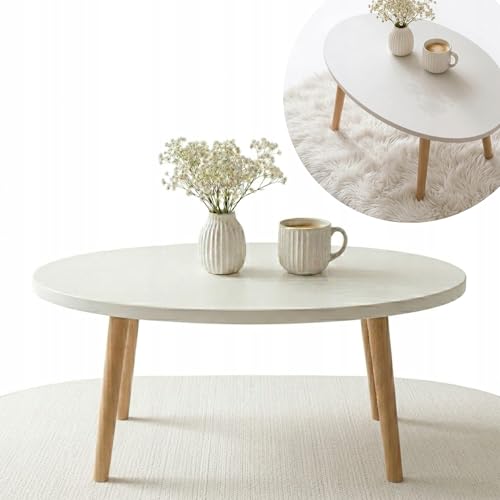
P&P Furniture Table basse blanche ovale 70 x 50 cm en bois scandinave
50 x 70 x 47 cm · Oval : 50 X 70 Cm
A short oval, 70 by 50, white lacquer, on angled wooden legs. Its 47 cm lands at standard seat height, so you won't lean forward. This size suits a two-seater or a reading corner; in front of a large sofa, it looks lost in the middle of the rug. The white lacquer, for its part, shows the smallest scratch.
As an Amazon Associate, we earn from qualifying purchases. The product links on this page may earn us a commission if you buy something — at no extra cost to you. Prices shown may have changed since we last checked.
Price alert
Tell me when the price drops
We watch the tables on this page for you. One email when one of them drops, nothing else.
Diameter Decides Everything Else
On a circular shape, length and width collapse into one measurement: the diameter. If the table sits away from any wall, our middle-of-the-room guide covers that placement in more depth. With children in the mix, our guide for a family with children adds a few extra safety-minded criteria. Two facing sofas raise a different question entirely, covered in our guide to two-sofa living rooms. It governs the usable surface and, above all, the distance you have to cover from the back of the sofa to reach something set in the centre. A close format is worth a look: which Coffee Table for the Middle of the Room?. The question comes up often, and which Coffee Table Against a Wall? answers it in detail.
Three reference points are enough. At 60 cm, you can set down two cups and a book: it's a side table, sized for an armchair or a two-seater sofa. At 70 cm, a meal tray fits comfortably and walking round the piece stays easy. At 80 cm, the piece becomes the centre of the room, but someone sunk into the seat can no longer reach the far edge without standing up: know that before confirming your order.
Don't trust mental arithmetic, because area doesn't track diameter in a straight line. An 80 cm disc covers roughly half a square metre, against barely 0.28 m² for a 60 cm one. Twenty extra centimetres on the tape nearly doubles the usable space. That's why a round table always looks more modest than it is, until you've actually filled it.
That leaves height. The tops gathered here range from 40 to 47.5 cm. Below 42 cm, you tower over the piece and your back works every time you reach for a cup; from 46 cm up, the top sits level with the cushion and setting down a plate takes no effort at all. Most sofas have a cushion top that sits 40 to 45 cm off the floor: rest the tape measure on it and you'll have your answer in ten seconds.
Round or Oval: What You Gain in Circulation
A piece with no corners changes how you move through the room. If a chaise longue sits alongside the sofa, our chaise longue coffee table guide tackles that exact layout. If square corners appeal more than a full circle, our square or oval comparison weighs both against each other. For a shape that keeps the same no-corner benefit with a longer profile, see our best oval coffee table round-up. Nothing catches your knee as you go round the sofa, and the route shortens because you follow the curve instead of two straight sides. In a living room that's constantly crossed — a door on one side, the kitchen on the other — that's this shape's number-one argument. A neighbouring question comes up often: which Coffee Table with Two Sofas? gives useful bearings.
Two situations make it an almost obvious choice. A home with young children, first: at forehead height, a sharp corner doesn't forgive, which is exactly why several makers round off the edge — the guide on which coffee table suits a home with a baby goes further on this point. A tight clearance, second: if you have less than a metre between the seat and the wall, having no corner hands you back the centimetres you were missing. Check that gap before opening a single product listing.
The oval plays the middle ground. It keeps rounded ends while stretching out, so it works alongside a three-seater sofa without leaving two big gaps on either side. Two models here use this shape, at 100 by 50 and 70 by 50: the depth stays shallow, the piece doesn't push into the room, and the length finally matches the seat.
The weak point lies elsewhere, and it's a clear one: in front of a corner sofa, a disc doesn't sit well. The return forms an L and the curve leaves a triangle of dead space you won't know what to do with. In that exact case, go for a rectangular top, or a pair of nesting tables spread across each arm.
Legs: What Holds, What Tips
Under a circular top, the leg does more than carry weight: it decides stability, the room left for your legs, and how fast you can clean. Laying a round top over herringbone flooring specifically? Our herringbone flooring guide walks through that exact pairing. A corner sofa changes that reach calculation again, as our guide to corner sofas explains. If sharp reference points matter more in your layout, our best square coffee table round-up covers that trade-off. Three families share this page. Readers starting from another constraint turn to which Coffee Table with a Corner Sofa?.
The central leg, called a spider base when its branches spread out near the floor, clears the whole underside. You move your legs in with nothing in the way, and a broom passes in one stroke. Check the base in a front-on photo: too narrow, and the piece tips as soon as someone leans on an edge — which is exactly where glasses get knocked over.
Four wooden legs, as on the beech model in this list, do the opposite: weight spread across four corners, no tipping possible, but four obstacles at floor level. The trouble starts with a thick rug. A slim leg sinks into the pile, the piece starts to wobble, and you end up sliding a shim underneath. If your rug is plush, rule out this kind of base from the start.
A metal frame is the go-to under heavy tops: sintered stone, tempered glass, natural stone. The question here isn't stability but contact with your floor. Look for a silicone or felt pad under each foot; without one, a steel tube scratches your parquet the first time you move it.
One last detail specific to glass: the top usually rests on suction cups or soft washers. They come loose over the years and the top starts spinning on its own. These parts are sold at any hardware shop — you just need to think of it before it starts sliding.
If your constraint is space rather than shape, two routes beat a small disc: nesting tables, which you spread out on evenings you have guests and tuck away the rest of the time, and small sizes, designed from the outset for studio flats, reading corners and busy living rooms where every centimetre of floor counts. If a footstool already sits next to your sofa, the guide on which coffee table pairs with a footstool is worth reading too.
If material will make the decision, know what each one will ask of you. Glass lightens an already busy room by letting the eye run through to the rug, but you'll wipe it daily. Wood warms up an overly mineral interior and can be repaired once it eventually marks. Marble takes almost anything you put on it, provided you give up moving it alone. And for a much lighter natural touch, look at rattan.
Lastly, if the piece also needs to store things or double as a dining surface in front of the television, look at storage models, whose drawers stay accessible at all times, or lift-top tables, which rise to elbow height in one motion. If budget is calling the shots, start with the affordable models page.
Worth knowing
Frequently asked questions
What diameter for a 3-seater sofa?
A three-seater runs close to 200 cm wide. An 80 cm disc covers the central portion of the seat and leaves each end clear. Below 70 cm, the piece floats in the middle of the room. If you want to run alongside the whole length, go for an oval instead.
Does a round coffee table take up less space?
For the same size, yes for floor area, no for clearance. An 80 cm disc covers less floor than a square of the same measurement, but it needs the same space around it. The gain shows in movement: you skim past the curve instead of going round two corners.
What tabletop height should I aim for?
Start by measuring your sofa cushion's height, usually between 40 and 45 cm. A top at that level, or three centimetres lower, lets you grab a glass without moving your torso. The models shown here range from 40 to 47.5 cm.
How do you look after a round glass top?
Lukewarm water, a drop of washing-up liquid, then dry immediately with a dry microfibre cloth: water marks come from drying, not the product. Avoid abrasive powder and ammonia, too often used, which eventually dull the polished edges of the top.
Does it work with a corner sofa?
Rarely. The sofa's return forms an L, and a curve leaves a triangle of dead space. Two solutions work better in that case: a rectangular top lined up along the longer arm, or two nesting tables spread across each wing.
Written by the Tavolia Bassio team
We don't test the furniture: we record each piece's measurements one by one and say where our figures come from. When a dimension is missing from a listing, we say so instead of guessing. Our method.


 P&P Furniture Table basse blanche oval
 GrandCA HOME Ensemble de 2 Tables Bass
 Vlsrka 80cm Table Basse Ronde en Verre