HomeShapeWhich Coffee Table for a Home with a Baby?
Shape
Which Coffee Table for a Home with a Baby?
A baby who's starting to move about sees your coffee table as something to hold onto, not as a piece of furniture. Three things matter before colour or style: the top's material, glass cracks under an impact while solid wood absorbs it better, rounded edges, and a height that doesn't invite climbing. Start by measuring your sofa's seat height: a coffee table should never exceed 45 centimetres, otherwise it ends up used as a stepping stool by a child testing out their leg strength. Look at these five models with that in mind rather than through a purely decorative lens, and remember that a piece that looks lovely in a photo can still be dangerous in a living room where someone is still crawling.
Before colour, look at the top's material. Shape can matter even more than material here, and the organic-form range removes hard corners altogether through its curved edges. Shape matters just as much as material here: the egg-shaped line-up removes the sharp corners of a fall altogether. Tempered glass withstands a light knock, but a glass table edge is still harder than a wooden one in a fall onto the seat, and it heats up or cools down much faster than a solid wood top. A thick laminated panel copes better with repeated knocks from a child banging on it while playing, without marking with every impact. Corners are the other risk with a small child, so our round coffee table selection gathers the shapes with no sharp edge at head height.
Also check stability before buying: a light table slides or tips if a child leans on it to pull themselves up off the floor. Press flat on a corner and push gently in the shop, or go by the weight stated on the product listing: heavier generally means more stable for this type of low furniture.
Key point Press flat on a corner and push gently in the shop, or go by the weight stated on the product listing: heavier generally means more stable for this type of low furniture.
Height, set against your sofa
A coffee table shouldn't exceed 45 centimetres in height, a rule that also applies to a home with a baby, with one nuance: the lower the table, the less a fall hurts if the child trips over it while walking. Also keep a real walkway between the sofa and the table, around 40 to 50 centimetres, so a child can crawl around without bumping into either piece each time. Since a crawling child spends the day on the floor, the guide to coffee tables for herringbone flooring covers feet that protect parquet. Keeping a clear walkway is easier with no corners in the way, which our pick of the best round coffee tables confirms.
Avoid models with a lift-top or moving mechanisms while the child explores everything with their hands: a moving part attracts exactly the kind of attention you're trying to avoid near a coffee table, and a curious finger quickly finds its way into a hinge.
Key point Avoid models with a lift-top or moving mechanisms while the child explores everything with their hands: a moving part attracts exactly the kind of attention you're trying to avoid near a coffee table.
Open storage, a tempting but flawed idea
A low open shelf fills up with books and magazines for the adult, and empties for the child: anything within reach gets explored, chewed or thrown to the floor within minutes. Keep this level for risk-free objects only, never a candle, a remote with visible batteries, or anything glass that could break. Family rooms often end up with seating on both sides, so the page on a coffee table between two sofas is worth reading next.
A closed compartment, even a simple one, really changes things: as long as a lid or a door holds the contents in, the coffee table becomes a storage piece again rather than a permanent point of access to everything you were trying to keep out of reach.
Key point A closed compartment.
Before confirming your choice
Always run your hand over the edges of the model you like, in the shop or in the detailed photos on the listing: a "rounded" corner on paper is sometimes just a slight bevel that stays hard to the touch. The furniture's weight also matters more than you'd think: a coffee table a child can pull along and shift on their own always ends up moving at the wrong moment. Since edges are the real worry, our pick of the best oval coffee tables gathers shapes with no sharp corner to bump into.
Finally, think ahead two or three years: a baby who crawls today will soon be standing on anything within reach, and a table too unstable to bear a full child's weight will quickly create a different kind of problem than sharp edges alone.
What parents often overlook
A thick rug placed under and around the coffee table cushions a fall far better than bare flooring, and it slows down a child running around the living room in socks. It's not just a decorative extra, it's often what prevents a real injury during those first wobbly steps around the furniture. Rugs aside, the shape of the piece matters too, and our pick of the best rectangular coffee tables helps you weigh that choice.
Also consider corner protectors, sold separately and compatible with most tops: they don't replace a model already designed with soft edges, but they add a useful safety margin on furniture bought before the child arrived, when nobody was really thinking about it yet.
Finally, don't neglect regular cleaning of low surfaces: a baby exploring the living room often puts their hands to their mouth right after touching the table, a reflex that makes keeping the top clean almost as important as its original shape.
A close-up on each model
The cheapest
Aibiju Table Basse, Table Centrale Ovale
40.64 cm x 88.9 cm x 43.18 cm · Brown Rustic + Black
An oval top measuring 88.9 cm with open storage at mid-height: handy for keeping books and toys within reach, but an open shelf at 40.6 cm off the ground empties fast once a child pulls on it to stand up. Brown Rustic + Black, the solid wood hides everyday knocks well, a real plus compared with a more fragile top. The limit here: nothing stops a crawling child emptying the shelf, so no fragile items or small detachable pieces at this level.
110 cm by 50 cm, rounded corners stated right on the product listing: that's the point that matters most in this line-up, a sharp corner at a stumbling child's head height hurts far more than a scuffed piece of furniture. The thick natural wood legs stabilise the piece at 40 cm, a solid base against a sideways push. The Black marble-effect top remains, however, a laminate finish, not real stone: it scratches under a hard object dragged across it, unlike what the finish suggests at first glance.
ELUCHANG Table Basse Plateau Relevable Extensible 4 en 1 Table à Mange
100x100x62cm · Black
A lift-top measuring 100 cm by 100 cm: a function built for a desk or a meal, not really for a living room with a toddler, since a lift mechanism adds a spot where small fingers could get caught while fiddling with it unsupervised. The closed compartments at least let you store sharp objects out of reach, something few models here offer. Black, the matt finish limits marks but not fiddling with the mechanism itself, worth watching closely if the child is already standing and curious about anything that moves.
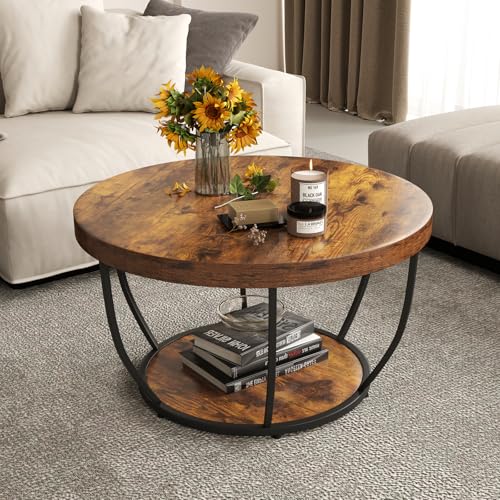
80 cm across for this round two-tier top: the round shape avoids sharp edges altogether, with no protruding corner at head height, a real plus with a baby who's starting to walk while holding onto furniture. At 45 cm tall, it stays low and doesn't tower over a child leaning on it. The lower storage level, Rustic, isn't enclosed: as with other low-shelf models on this page, whatever's left there without a second thought eventually ends up in the hands of a child crawling underneath.
We watch the tables on this page for you. One email when one of them drops, nothing else.
As an Amazon Associate, we earn from qualifying purchases. The product links on this page may earn us a commission if you buy something — at no extra cost to you. Prices shown may have changed since we last checked.
Written by the Tavolia Bassio team
We don't test the furniture: we record each piece's measurements one by one and say where our figures come from. When a dimension is missing from a listing, we say so instead of guessing. Our method.