Pairing a footstool with a coffee table only works if the two sit at roughly the same height: a footstool taller than the table forces you to reach up to set down a glass, a footstool that's too low breaks the visual line between the two seating pieces. Shape matters too: a round footstool nestles more naturally against a round or oval table than against the corner of a rectangular top. Five models are gathered here to compare height first, before shape or material, since height decides whether the pairing truly works in your living room. Storage type, where it exists, also comes into play: a footstool sometimes serves as storage itself, and it would be a shame to double up that function with a table that already does the same job.
A standard footstool usually sits between 35 and 45 cm tall, close to a sofa's seat height. Rounded, elliptical lines echo the same soft language as our pick of nature-inspired designs. Shape matters here too, and the elliptical-form models pair especially well with a footstool's rounded lines. Next to a footstool, the elongated-form models make that small height gap much easier to keep consistent. To pair well with the coffee table, aim for a gap of a few centimetres at most between the two: beyond that, one of them becomes awkward for setting down a tray or a cup. A footstool sits far more naturally beside a curved edge, which is why our round coffee table guide is worth a look before you pair the two.
A coffee table too tall relative to the footstool forces you to reach up with every movement; one too low draws the eye down to the floor rather than to the seat. Measure your current footstool before choosing the table, rather than the other way round, the footstool is often already there when the coffee table arrives last.
A gap of just a few centimetres remains tolerable, especially if the footstool isn't kept permanently pushed against the table. In a living room where the footstool moves around often, this criterion matters less than in a fixed corner where the two pieces sit against each other all day, from morning to night, never moved even by a centimetre, week after week.
Key point In a living room where the footstool moves around often.
Round or oval: what pairs best with a footstool
A round table naturally suits a round or square footstool: the curved lines of both echo each other without creating an edge that catches the eye or a shin as you walk past. It's the easiest combination to get right in a medium-sized living room. Room shape guides the same choice, since a coffee table for a square living room usually calls for a round or square top too. Seating count changes the geometry, and a coffee table with two sofas facing each other has to serve both sides equally.
An oval or rectangular table, being longer, leaves more room to slide a footstool to one side without blocking the main walkway. It suits a long living room better, where a round table would leave an awkward gap along the edges.
Nesting models offer a third option: separate one of the two tables to slot the footstool between the two surfaces, a handy spot for setting a tray within reach without leaning over.
An extendable top with leaves, found on one of the models on this page, changes things another way: it lets you temporarily pull the footstool back to enlarge the flat surface, useful for a meal or a board game set out on the floor.
Key point An extendable top with leaves.
Where to place the footstool, and how much space to leave
Keep at least 40 cm of clearance between the coffee table and the footstool once both are set up side by side, so the living room doesn't turn into an obstacle course. A footstool tucked under a lift-top table loses all its point: the mechanism can no longer extend without pushing it out of the way first. Clearance becomes critical once nothing sits against a wall, which is exactly what a coffee table for the middle of the room has to manage.
If the living room hosts guests often, a mobile footstool next to a fixed table remains the simplest combination to rearrange: you move it in a second, while the coffee table stays put.
Key point If the living room hosts guests often, a mobile footstool next to a fixed table remains the simplest combination to rearrange: you move it in a second, while the coffee table stays put.
Material, a secondary but real factor
A fabric or velvet footstool pairs more naturally with a wooden table than with a glass top, whose cold visual clashes with the fabric's comfort. A leather or faux-leather footstool works just as well with wood or metal, two materials that echo its more structured feel. Add a corner seat and geometry takes over, which is what our guide to a coffee table with a corner sofa deals with.
If the footstool also doubles as an extra seat, choose a table whose top doesn't overhang its legs: a wide overhang gets in the way of legs when someone sits on the footstool right next to it.
Finally, think about the relative weight of the two pieces: a light footstool pushes easily with a foot, while a heavy solid wood table stays put once positioned. This difference in mobility directly affects how you'll rearrange the pair day to day, depending on whether you're hosting or not.
Key point This difference in mobility directly affects how you'll rearrange the pair day to day, depending on whether you're hosting or not.
Nesting tables: a real option with a footstool
A nesting table offers flexibility fixed models don't have: pull out the small table to slide it right against the footstool, while keeping the large one in front of the sofa. This setup brings a real surface closer to the footstool without sacrificing the living room's main table. Patterned floors add their own busyness, so a coffee table with herringbone flooring usually calls for a plain top and a simple base.
The downside of a nesting pair: the smaller table often sits lower than the footstool itself, which limits its use to something light, a cup or a book, rather than a full meal set down on top. Always check the height of both pieces before pairing them with your footstool.
Key point Always check the height of both pieces before pairing them with your footstool.
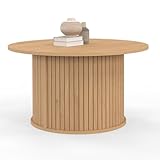
Ronde, 70 cm de diamètre x 40 cm de hauteur · Wood
70 cm across for this IDMarket table in Wood with a slatted effect, standing 40 cm tall, a figure close to most footstools on the market. The spaced-slat top lets air and dust through, handy for cleaning but less so for setting down a slim object that could slip between two wooden slats, especially a narrow-based glass.
107 cm by 67 cm, one of the longer tables on this page, a Hela Tische in Log with an extendable top thanks to side leaves for the odd meal. At 53 cm, it stands taller than most footstools: better suited to an already tall footstool, or accept a slight height gap once both pieces sit side by side.
70 x 70 x 40 cm et 40 x 40 x 50 cm · Grain de Wood Dark
70 cm across for the larger of a pair of JZGORC nesting tables in Grain de Wood Dark, standing 40 cm tall, a height that lines up well with a standard footstool. The rounded corners avoid catching on the footstool if pushed right up against it. The fibreboard panel, though, stays lighter than solid wood, so a touch less stable if the footstool is used repeatedly through the day as a push-off point to stand up.
This pair of OHMG nesting tables, in White+gold-70*70*45cm, with a waterproof MDF marble-effect top, doesn't give any reliable measurement in our records, unlike other models on this page. That's its real limitation: before pairing it with a footstool, measure the stated height from the product listing itself rather than relying on the visuals shown online.
PUGSDRLY Table Basse Ronde 2 Plateaux en Verre trempé
90x70x44cm · Wood
90 cm by 70 cm, a PUGSDRLY table with two stacked round tempered-glass tops on a wood-effect frame. At 44 cm, it comes close to a typical footstool's height. Its downside: the double glass top needs more upkeep than a single-glass coffee table, a regular dry wipe for fingerprints on two levels instead of one, morning and evening in a household with children.
We watch the tables on this page for you. One email when one of them drops, nothing else.
As an Amazon Associate, we earn from qualifying purchases. The product links on this page may earn us a commission if you buy something — at no extra cost to you. Prices shown may have changed since we last checked.
Written by the Tavolia Bassio team
We don't test the furniture: we record each piece's measurements one by one and say where our figures come from. When a dimension is missing from a listing, we say so instead of guessing. Our method.