HomeStyleVintage or Design: Which Coffee Table Should You Choose?
Style
Vintage or Design: Which Coffee Table Should You Choose?
Vintage style looks for wood that keeps its grain, a pale finish or a tone that already looks lived-in; design style, more broadly, leans towards more technical materials — metal, lift mechanisms, treated oak — and cleaner lines. The first brings warmth to a very new living room, the second gives structure to an interior that already lacks character of its own. Keep in mind, as a rule of thumb before choosing, that a well-proportioned coffee table covers roughly two-thirds of the sofa it sits in front of: a starting point common to both styles before you even settle on the texture of the top.
Which one to choose, based on your living room
If budget is the deciding factor
Table Basse Tibor Style scandinave Design Vintage Nordique Table de Sa
VOWNER Table Basse Relevable Transformable Table à Manger
100 x 106 x 65.5 CM · White
106 cm by 100 cm, with a White lift-top and four built-in storage stools: this modular system, designed for eating in front of the sofa, clearly belongs to functional design rather than aged vintage. Once raised, it works as a genuine dining table for an impromptu meal. The trade-off: four stools to stow and pull out with every use take more handling than a plain fixed top, on top of the space they take up once out.
110 cm by 48 cm, with a Grey Washed top in a worked texture and distinct side panels: this visible grain and washed tone bring the model closer to an older style than the smooth tops usually seen on this page. Hidden storage under the 41 cm-high top stays out of sight once closed. The trade-off: the centre section that lifts, handy as an improvised workspace, does break up the continuous line vintage style is otherwise going for.
Table Basse Tibor Style scandinave Design Vintage Nordique Table de Sa
90 x 36 x 60 cm · White
90 cm by 60 cm in solid pine under a White finish: the visible solid wood and two old-style drawers are the clearest vintage signature in this selection, with no gimmicks or hidden mechanism. At 36 cm high, it stays low and stocky like the older pieces found at a flea market. The trade-off: solid pine marks more easily than treated oak under an item set down carelessly, a mark that stays visible for good.
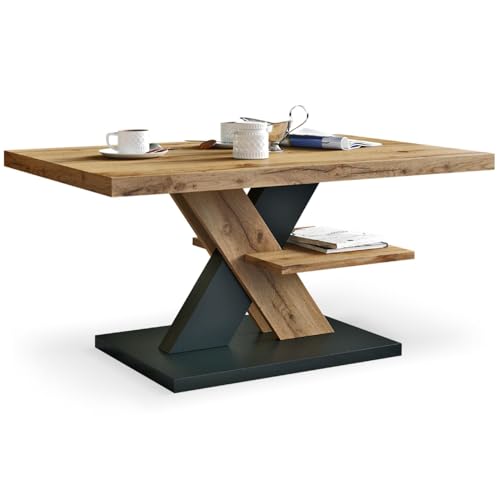
90 cm to a side, with a Oak Wotan oak top on matt black X-crossed legs: this cross structure and the oak-and-metal mix belong more to contemporary design than to true vintage, despite the wood tone used on top. At 45 cm, the middle shelf keeps magazines and books within reach. The limit: crossed metal legs mark the floor more easily than a solid wood leg, especially if the table is moved often for cleaning.
Vintage style favours visible solid wood, a finish that lets the grain show through, and stocky shapes close to older furniture: classic drawers, solid legs with no gimmicks. Design style's leaner lines lead naturally into clean-lined Nordic tables, which push that same simplicity a step further. The contemporary tops follow that same logic closely, favouring smooth surfaces and understated, pared-back legs. Design style leans towards more worked materials: lift mechanisms, metal structures, treated oak rather than raw wood left on show. Worked materials against honest grain splits another pair too, examined in the Scandinavian or vintage coffee table comparison.
One limit stays common to both styles: past 45 centimetres high, a coffee table starts getting in the way of use from the sofa; it's the texture of the top and whether or not there's a mechanism that really tells the two apart, not the height of the piece.
Key point One limit stays common to both styles: past 45 centimetres high.
The models on the vintage side
The solid pine model with two drawers and a pale finish is the closest thing here to an old-style coffee table: visible wood, simple shapes, classic drawer storage rather than an open side compartment. The worked-texture, washed-tone model comes close too, with a wood grain that recalls a piece aged by time and years of use. Visible wood covers two very different moods, separated in our comparison of Scandinavian or rustic pieces.
Both models suit a living room already furnished with older or second-hand pieces, where a top that's too smooth and too new would clash with the rest of the furniture in place.
Key point Both models suit a living room already furnished with older or second-hand pieces, where a top that's too smooth and too new would clash with the rest of the furniture in place.
The models on the design side
The lift-top model with four stools and the oak-and-metal crossed-leg model rely on function and structure rather than patina: a mechanism that transforms, a cross base that visually structures the space under the room's top. These are choices that stand out through their use as much as their own style. Patina reads differently among textiles, as the coffee table for a boho living room page shows when raw wood meets patterns and rugs.
In a very contemporary living room, both models fit naturally, whereas raw vintage wood there would look more like an add-on with no real link to the rest.
Key point In a very contemporary living room, both models fit naturally, whereas raw vintage wood there would look more like an add-on with no real link to the rest.
Which room suits which style
Don't cut the space around the piece too tight — a little under half a metre is generally enough, a guide that holds here too whatever style you choose. A very modern living room, with clean lines and little raw material, gains warmth from a solid-wood vintage table; a living room already made up of older pieces or aged materials takes a design table with more technical lines better, as a counterpoint to the rest. The same counterpoint logic applies in older buildings, which the coffee table for a country house page works through room by room.
If you already have a striking older piece in the room, a second vintage item can visually overload the whole thing: design style then brings a genuinely useful breathing space.
Key point If you already have a striking older piece in the room, a second vintage item can visually overload the whole thing: design style then brings a genuinely useful breathing space.
The verdict for your living room
A new living room, still with cold lines, does well with the solid pine with drawers or the worked-texture top: they bring immediate warmth the room is still missing. A living room that already has several older pieces or aged wood gets more from the lift-top model or the oak-and-metal structure, which adds structure without overloading the style already present everywhere else.
Between the two, the texture of the top remains the most reliable way to decide: wood that keeps its grain leans vintage, a mechanism or a metal structure leans towards design.
Key point Between the two, the texture of the top remains the most reliable way to decide: wood that keeps its grain leans vintage, a mechanism or a metal structure leans towards design.
Upkeep, depending on the style you choose
Old-style solid pine needs the occasional wax or oil to keep its shine, a step vintage style fully embraces as part of the piece's charm. The worked-texture top, meanwhile, holds on to a little more dust in its relief than a perfectly smooth surface.
On the design side, treated oak on crossed legs stands up well to everyday use, but the matt black metal legs show fine scratches faster than brushed metal would. The lift mechanism with stools, meanwhile, needs an occasional check that the struts are still holding the weight without sagging.
Key point The lift mechanism with stools, meanwhile, needs an occasional check that the struts are still holding the weight without sagging.
Deciding with one simple question
Start by asking whether your living room already has a genuinely old, second-hand or inherited piece that sets the tone for the rest of the décor. If it does, a second table in the same spirit reinforces that mood; too modern a table next to it, on the other hand, risks making the older piece look out of place rather than shown off by its surroundings.
If your living room is still brand new, with nothing standing out, a single vintage piece is usually enough to add character without locking the whole room into one style. The solid pine model with drawers plays that role of a first piece with history well, leaving you free to add other aged touches later on — a second-hand frame or an old armchair, for instance — without ever forcing the style on the whole room at once.
Either way, avoid pairing a heavily worked table — lift mechanism or cross structure — with a sofa that's already full of detail: two pieces that each draw the eye end up competing rather than forming a coherent whole in the room.
Also check the actual weight of the piece before settling on your choice: a solid-wood vintage piece is hard to shift once in place, while a lighter design model, often on castors or with slim legs, adjusts more easily if you rearrange the room in the months after buying.
One last thing to keep in mind: the style of a living room rarely changes all at once. Starting with a single standout piece, vintage or design, and watching how it settles into the room over a few weeks is safer than changing everything at once on the strength of a photo seen online, before even seeing the piece for real at home, in its own morning or evening light, next to the other furniture you already know by heart after years of living with it.
Key point Starting with a single standout piece.
Price alert
Tell me when the price drops
We watch the tables on this page for you. One email when one of them drops, nothing else.
As an Amazon Associate, we earn from qualifying purchases. The product links on this page may earn us a commission if you buy something — at no extra cost to you. Prices shown may have changed since we last checked.
Written by the Tavolia Bassio team
We don't test the furniture: we record each piece's measurements one by one and say where our figures come from. When a dimension is missing from a listing, we say so instead of guessing. Our method.


 VOWNER Table Basse Relevable Transform