A vintage coffee table doesn't try to imitate the new: it embraces solid wood that marks, patinated metal and the rounded shapes of decades past. The six models on this page range from raw mango wood to smoked glass, taking in hand-worked pine along the way. Vintage style likes pieces that take up their space: measure generously before ordering rather than trusting the photo alone. Some of these tables also embrace their small manufacturing quirks, which is exactly what gives them character.
The models, one by one
vidaXL Table Basse Bois de manguier Massif 88x50x40 cm
40D x 88W x 50H cm · Wood Natural
This vintage piece measures 88 cm long, 50 cm deep and 40 cm high, in solid mango wood: each top keeps its own grain markings, so no two tables produced are exactly alike — a real hallmark of vintage style. Solid wood needs dusting more often than a lacquered top, since it holds on to fine dust in its visible grain.
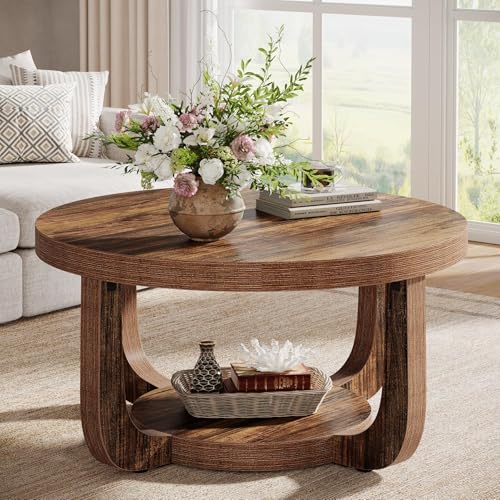
This vintage piece measures 160 cm long, 90 cm deep and 30 cm high: this round, rustic-brown table stacks two levels of storage and display, with a thick-panelled top that comfortably takes weight. Its rustic brown shade sits well with an aged-leather sofa. The trade-off of its size: at 160 cm on the floor, it's wide for a small living room, so measure the space around it before confirming.
This vintage piece measures 60 cm long, 60 cm deep and 42 cm high: this round pine table on iron legs carries a "water ripple" veneer pattern, a detail that sets it apart from a plain top. Its compact size makes it easy to fit into a small living room. Pine veneer, unlike a thick solid piece, copes less well with a hard knock against the edge of the top.
32 x 32 x 55 cm (L x l x H) · Vintage Brown, Black
This vintage piece measures 55 cm high on a 32 cm base: more a small side table than a central coffee table, this two-shelf model fits better next to an armchair or at the end of a sofa. Its vintage brown-and-black shade suits an industrial interior. Its small size is also its limit: placed alone in front of a large three-seater sofa, it looks isolated in the middle of the rug.
This vintage piece measures 80 cm long, 40 cm deep and 40 cm high: this folding vintage-brown table folds flat against a wall when the room is needed for something else, a rare advantage on this page. The legs lock in place with a magnetic system that stops them wobbling on the floor. Once folded, it can no longer act as a spare surface: it's one or the other.
Artloge Table Basse Ronde en Verre 2 Niveaux pour Salon Chambre
80_x_80_x_46.5_cm · Brown
This vintage piece measures 80 cm long, 80 cm deep and 46.5 cm high: this brown model pairs an 8mm tempered-glass top with a lower sintered-stone shelf, a mix of materials that breaks from the usual all-wood vintage look. The black iron frame creates a floating effect. The glass on top, however, holds on to fingerprints more than a wood or stone surface.
Unlike smooth, brand-new pieces, vintage style likes wood that keeps its knots and metal that develops a patina. For the opposite effect entirely, a Scandinavian coffee table favours a clean, uniform finish over any visible wear. If those visible marks aren't what you're after, the contemporary-style models go the opposite way, favouring flawless, uniform surfaces. A perfectly uniform top, in fact, often ruins the effect being aimed for: it's the visible grain that makes the piece, not industrial perfection.
That means different upkeep: a dry cloth is enough for solid wood, but avoid abrasive products that wipe away the very patina you came for.
If raw metal appeals more than that patina, the industrial or vintage coffee table comparison is worth reading first. On the glass or sintered-stone models, wipe them down weekly to keep the shine that contrasts with the rest of the older-looking furniture.
Key point On the glass or sintered-stone models, wipe them down weekly to keep the shine that contrasts with the rest of the older-looking furniture.
Solid wood, veneer, glass: what it changes day to day
Solid wood takes knocks better than thin veneer, but costs more to produce, which explains the price gap between the models on this page. A damaged veneer can't be sanded back like solid wood: a deep scratch stays visible for good.
Tempered glass, for its part, copes with an everyday knock from crockery without shattering into sharp shards — always check for that wording before buying any table with a glass top, vintage or otherwise.
For cleaner lines instead, the modern or vintage coffee table comparison covers that trade-off. Metal, used for legs on several models here, brings stability but none of its own warmth: it's usually the wood or glass sitting on top that sets the vintage tone, with the metal staying in the background, almost always black or dark brown.
Height against your sofa
The rule doesn't change with the style: aim for a height level with, or slightly below, your sofa seat, usually somewhere between 45 and 60 cm. Compare the figure in the table below against your own seat before ordering — a deep sofa sits you lower than an upright one.
For pale wood and slim legs instead, the Scandinavian or vintage coffee table comparison is worth reading. Also leave real room to get up from the sofa without catching the table's edge: give yourself extra space with the more imposing models in this selection, especially those over 100 cm long.
Key point Also leave real room to get up from the sofa without catching the table's edge: give yourself extra space with the more imposing models in this selection, especially those over 100 cm long.
Getting the vintage look right
Vintage style is recognised by specific details: turned or X-shaped legs, visible handles, rustic brown or tan shades rather than the matt black of modern lines. None of the six models above is an actual antique piece — these are new items made in that style, with all the advantages of new furniture: a warranty, simple assembly, availability.
A genuine second-hand vintage piece would often cost more and need restoring before use: stripping, sanding, sometimes a whole new coat of varnish or stain. These six tables skip that whole process while keeping the look you're after straight from delivery.
If a more sculptural top appeals too, the vintage or design coffee table comparison is worth a read. Before choosing between wood and glass, think about your living room's overall mood: an interior already busy with texture (thick rugs, textured cushions) copes better with a glass top that lightens the whole look, rather than another solid block of wood.
Key point Before choosing between wood and glass.
Pairing a vintage table with newer furniture
Many living rooms today pair a clean-lined contemporary sofa with an older-inspired coffee table: the contrast often works better than a perfectly matched set, which can quickly look as static as a shop window.
Raw or patinated wood, like that of the mango or pine models on this page, brings warmth to a grey or beige fabric sofa, shades that are very common in recent interiors. A leather sofa, by contrast, pairs naturally with the black metal of X- or cross-shaped legs.
For an even more worn-in, farmhouse feel, the vintage or rustic coffee table comparison is worth reading too. That said, avoid piling on too many different styles around the same coffee table: a heavily patterned rug next to an already elaborate top (ripple pattern, fluting) visually overloads the space rather than enriching it.
Key point That said, avoid piling on too many different styles around the same coffee table: a heavily patterned rug next to an already elaborate top (ripple pattern, fluting) visually overloads the space rather than enriching it.
What justifies the price of a vintage piece
Solid wood, wrought iron or quality tempered glass cost more to produce than a standard panel, which explains the price range across the six models featured here. It's no accident that the most elaborate tables, combining several materials, sit at the top of that range. The same material logic drives prices elsewhere too, and our design coffee table selection makes it easy to see what you pay for on each model.
Size matters too: a small side table logically needs less raw material than a large rectangular one, and its price follows that logic more than any simple matter of style.
One last pointer before comparing prices: a moving mechanism, such as a folding or locking top, adds a manufacturing cost that a plain, fixed-structure table doesn't carry. That's not a sign of higher quality in itself, just an extra function you pay for.
Key point That's not a sign of higher quality in itself, just an extra function you pay for.
We watch the tables on this page for you. One email when one of them drops, nothing else.
As an Amazon Associate, we earn from qualifying purchases. The product links on this page may earn us a commission if you buy something — at no extra cost to you. Prices shown may have changed since we last checked.
Written by the Tavolia Bassio team
We don't test the furniture: we record each piece's measurements one by one and say where our figures come from. When a dimension is missing from a listing, we say so instead of guessing. Our method.



 CHOEZON Table d’Appoint Ronde
 OCTORO Table Basse Pliante
 Tribesigns Table basse ronde
 vidaXL Table Basse Bois de manguier Ma
 Artloge Table Basse Ronde en Verre 2 N
 Zouron Lot de 1 Table Basse Ronde en p