HomeStyleModern or Design: Which Coffee Table Should You Choose?
Style
Modern or Design: Which Coffee Table Should You Choose?
'Modern' and 'design' get lumped together by every salesperson, yet they pull a living room in two different directions. Modern relies on simple lines and a material that doesn't draw attention: laminated MDF, a plain top, a discreet frame that lets the rest of the room's décor do the talking. Design goes the other way, chasing the piece people notice the moment they walk in — a base that swivels, a top that lifts with one movement, a shade that deliberately clashes with the rest of the furniture. Neither camp wins outright: it all depends on what your living room already has, and what it's still missing. Four tables, two camps, to help you choose without picking the wrong piece or the wrong budget. Our dedicated design coffee table range and modern coffee table selection both go further into each camp on its own.
Which one to choose, based on your living room
If budget is the deciding factor
[en.casa] Table Basse de Salon avec Plateau Rond Table d'Appoint Style
tectake® Table Basse Rectangulaire Design Moderne Aspect Marbre Blanc
120 x 60 x 35 cm · Look Marble White
At 120 cm long and 35 cm high, this Look Marble White top imitates marble on a sturdy MDF frame: the look is neat without the weight or the price of real stone. The modern camp shows itself well in this plain rectangle, built for a living room that wants no frills and no strongly patterned material. The U-shaped base opens up the view underneath the top, lightening the silhouette further still. But MDF remains a reconstituted wood panel, not solid timber: a hard knock on the corner leaves a white mark that the lacquer can't hide, unlike real marble, which takes the hit better.
[en.casa] Table Basse de Salon avec Plateau Rond Table d'Appoint Style
80 x 42 cm · Effect Marble White
A round 80 cm top in a Effect Marble White finish, set on a base that doesn't try to draw the eye: this is the compact version of the modern camp, built for a corner of the room rather than a large central rectangle. At 42 cm, it slots easily between two armchairs without ever dominating the room. Its stable frame limits movement when a loaded tray is set down on it. Its small size, on the other hand, limits what you can actually fit on it: an aperitif tray and two cups are as much as it takes, no more if you're hosting several people.
VOWNER Table Basse Relevable Extensible Table à Manger
120 L x 66,5 W x 60 H cm · White
Here's the design camp in full: 120 cm long, this White table goes from coffee table to dining table in a single movement, the top rising well above sofa height once fully lifted. The lift mechanism makes the whole character of the piece, the one you're happy to show off to guests rather than hide away. That versatility comes at a cost in discretion: raised, it takes over the centre of the room and stops fading into the background like a classic coffee table. The mechanism, sturdy as it is, also adds weight: don't expect to move it with one hand the way you would a fixed model.
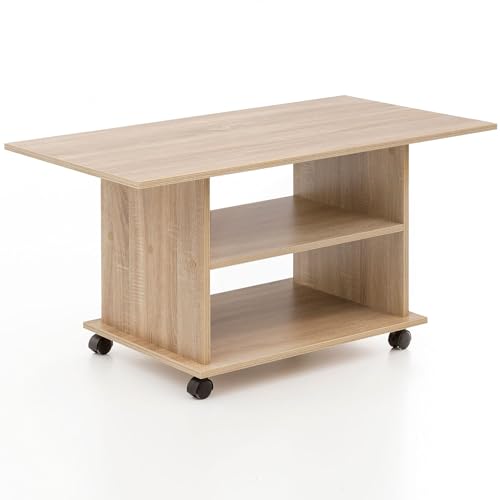
95 cm by 54.5 cm, a swivelling Sonoma oak top mounted on castors that let it glide towards the sofa with one push. This is design's second face: here, the originality comes from the movement rather than the shape of the top. At 51 cm high, it passes under most armrests without brushing against them. The castors, handy for bringing it closer to the sofa, need a flat floor in return: they roll poorly on a long-pile rug, and the swivel loses its whole point if the table stays stuck in the same spot.
Modern works in almost any room, precisely because it doesn't try to dominate: a plain top fades behind a packed bookshelf or a wall of frames, and it goes with a sofa in almost any colour. Design, on the other hand, sometimes borrows from the past too, and tables with old-world charm fit that same bolder statement. Design, on the other hand, often leans toward a bolder statement, and an industrial-edge design fits that same room-defining role. Design, on the other hand, needs space around it to breathe, or the statement piece you wanted to show off drowns in the rest of the furniture and loses its whole effect. Should your room have the space to let a statement piece breathe, our ranking of the best design coffee table shows the ones worth that room.
In a living room open onto the kitchen, design often wins out: it's the piece the eye meets first on walking in, and it deserves a real role rather than being pushed into the background. In a smaller room, or one already full of furniture, modern avoids that overloaded feel and lets the room breathe.
Natural light matters too: a pale top from the modern camp bounces light back and visually enlarges a dark room, while a darker top from the design camp needs a room that's already well lit, so it doesn't darken the living room further.
Key point Natural light matters too: a pale top from the modern camp bounces light back and visually enlarges a dark room.
Your sofa decides the height
The rule doesn't change whichever camp you pick: a coffee table stays below seat height, around 45 cm at most, so the movement of setting down a glass goes downward rather than up. On a standard sofa seat, between 45 and 60 cm, none of the four tables on this page go past that limit. Once the height rule has done its job, our ranking of the best modern coffee table shows which plain tops still hold their own in a busy room.
Think about length too: aiming for roughly two-thirds of your sofa's length keeps a good visual balance, neither lost in front of a three-seater nor overhanging a two-seater and leaving barely any room to walk around it.
A low, deep sofa, common in Scandinavian-style living rooms, suits a table that stays close to the floor; a taller sofa, in a more classic style, easily takes a table that comes close to 45 cm without ever going past it.
Key point A low, deep sofa, common in Scandinavian-style living rooms, suits a table that stays close to the floor; a taller sofa, in a more classic style, easily takes a table that comes close to 45 cm without ever going past it.
The verdict, case by case
Studio or small living room: go for the modern camp — its simple lines add no extra visual weight to a space that's already tight, and a pale top even helps the room look bigger to anyone walking in. Should a tight room leave you wanting warmth rather than plain lines, our ranking of the best rustic coffee table offers a third way.
A living room that hosts often: the design camp makes more sense here, the table becomes a talking point rather than just somewhere to set down a glass between conversations.
Need to turn the table into a dining spot: the lift-top version from the design camp answers that need directly, something none of the fixed modern tables on this page offer. Tight budget and everyday use: the modern camp is usually the safer choice, with no mechanism to maintain and no moving part to keep an eye on over time.
Key point Tight budget and everyday use: the modern camp is usually the safer choice, with no mechanism to maintain and no moving part to keep an eye on over time.
Budget and durability, the two sides of the coin
The modern camp, with no mechanism and no moving part, generally needs less upkeep over time: a fixed top doesn't come loose, doesn't creak with the years, and never needs a hidden screw tightened under some mechanism. It's also often the simplest frame to build, which shows in the budget left over for the rest of the room. Simple frames often come straight from industrial design, so the best industrial coffee table shortlist shows where that saving actually goes.
The design camp sometimes carries a mechanical system — gas strut, swivel, castors — which adds one more wearing part. Nothing to worry about on well-made hardware, but repeated rough handling wears a mechanism down faster than a plain fixed leg that never moves at all.
Before deciding, ask yourself how often you'll actually use the feature that gives the design camp its character: a lift-top table that never gets lifted loses its whole appeal next to a fixed modern table, which is simpler and often more stable day to day.
The lacquered MDF of the modern camp scratches less easily than you'd think from an object set down gently, but a hard knock on the corner remains its weak point in common with most marble- or wood-effect tops in this range.
One last thing to check before ordering: the listed weight of the piece. A fixed modern table usually moves with one hand when you're vacuuming, while a design table fitted with a mechanism often needs two people if you're rearranging the room for an evening.
Also look at the warranty the seller states on the mechanism itself, rather than on the whole frame: it's usually the moving part that wears out first on a design table, well before the top or the legs show any sign of fatigue. A seller who spells out that warranty in detail generally trusts their own mechanism more than one who stays vague on this point, so it's worth checking before confirming the order rather than after delivery. This check takes barely two minutes and saves plenty of disappointment once the piece has been sitting in the living room for several months.
Key point This check takes barely two minutes and saves plenty of disappointment once the piece has been sitting in the living room for several months.
Price alert
Tell me when the price drops
We watch the tables on this page for you. One email when one of them drops, nothing else.
As an Amazon Associate, we earn from qualifying purchases. The product links on this page may earn us a commission if you buy something — at no extra cost to you. Prices shown may have changed since we last checked.
Written by the Tavolia Bassio team
We don't test the furniture: we record each piece's measurements one by one and say where our figures come from. When a dimension is missing from a listing, we say so instead of guessing. Our method.
![[en.casa] Table Basse de Salon avec Plateau Rond Table d'Appoint Style Intemporel Bout de Canapé pour Salle de](https://m.media-amazon.com/images/I/51dALTw1gqL._SL160_.jpg)


 VOWNER Table Basse Relevable Extensibl
![[en.casa] Table Basse de Salon avec Plateau Rond Table d'Appoint Style Intemporel Bout de Canapé pour Salle de](https://m.media-amazon.com/images/I/51dALTw1gqL._SL500_.jpg)