Japandi rests on three simple ideas: light wood rather than dark wood, straight lines rather than fussy curves, and a colour that never tries to stand out. A coffee table that ticks these three boxes settles into a living room without ever dominating it, unlike a lacquered top or a chrome frame, which demand attention the moment you walk into the room. The most common mistake isn't the choice of wood, which most buyers already get right, but the height: a table that's too tall breaks the low, grounded feel that defines the style, even with the right wood tone. Five models here, from solid oak to Scandinavian white, to help you find a piece that stays discreet without becoming invisible, and that keeps a real function rather than becoming a mere decorative object. Industrial leans harder than japandi ever does, and the round storage roundup sits closer to that softer, pared-back mood instead. For more pared-back statement pieces in this vein, our full design coffee table range is worth a look.
Which one to choose, based on your living room
If budget is the deciding factor
IDMarket, Lot de 3 Tables Basses gigognes Gaia laquées Blanc scandinav
A successful Japandi look is recognised first by its tone: light oak, ash or beech, never a dark wood that weighs the room down. That same pale-wood preference runs through Nordic style, where tables built in Nordic style share almost the identical palette. Colour matters more than shape — a round or square top works perfectly well, as long as the wood stays pale and any metal stays matte black rather than bright gold, which clashes with a palette designed to stay understated.
Check the height before ordering: a coffee table rarely exceeds 45 cm, and against a sofa seat that runs from 45 to 60 cm, it should stay below, never level with or above it. A modern coffee table shares that same restraint if you'd rather skip wood tones altogether. This detail, more than the exact wood tone, is what makes a table "look" Japandi once it's in the room.
Key point This detail, more than the exact wood tone, is what makes a table "look" Japandi once it's in the room.
Leave room to breathe around the table
The Japandi style lives on empty space as much as on objects: keep a 40 to 50 cm gap between the table and the sofa, enough to move around without brushing either one. A table too large for a small room breaks the intended effect, however handsome it is, giving the impression of an imposed piece rather than a chosen one. Curious what the season favours? The coffee table in 2026 page reviews the shapes and tones now leading, empty space included.
As a rule of thumb for length, aim for two-thirds of your sofa: beyond that, the table visually overflows and the balance of the room shifts, which runs against the restraint this style calls for.
Key point As a rule of thumb for length, aim for two-thirds of your sofa: beyond that, the table visually overflows and the balance of the room shifts, which runs against the restraint this style calls for.
Caring for a light top without spoiling it
Light wood shows water marks and glass rings more than dark wood does: a coaster used every time avoids halos that stay visible for months on a pale tone. A dry cloth is enough for everyday dust. When the marks have already won, the coffee table to replace an old one page helps you avoid repeating the same finish mistake.
Avoid heavily scented or oily care products on untreated light wood: they often leave a film that slightly darkens the tone, the exact opposite of the look Japandi is after.
Key point Avoid heavily scented or oily care products on untreated light wood: they often leave a film that slightly darkens the tone, the exact opposite of the look Japandi is after.
Metal, discreet or absent depending on the model
Japandi tolerates a metal frame, but only if it stays slim and dark: a matte black frame blends into the wood without competing with it, whereas gold or chrome metal instantly pulls the eye towards the structure rather than the material.
On models without visible metal, stability rests entirely on the thickness of the wood: a thin top can flex slightly under a heavy object placed in the centre, worth checking before setting a vase or a stack of books on it.
Key point On models without visible metal.
A living room that ages without going out of style
Part of Japandi's appeal is how long it lasts: a light wood tone and a plain shape outlast trends better than a bright colour or a sculpted form, which quickly date a living room once the fashion moves on.
Rustic texture leans into imperfection, while at the opposite end tables mimicking natural marble lean into polish and precision instead. There is a real trade-off to accept: a style this restrained leaves little room for colourful accessories on top, or it risks breaking the balance sought between the wood, the space and the light.
Key point There is a real trade-off to accept: a style this restrained leaves little room for colourful accessories on top, or it risks breaking the balance sought between the wood, the space and the light.
Choosing the shape, round or rectangular
A round top softens a room already full of right angles — door frame, sofa, bookshelf — and leans a little closer to the Japanese half of the style than a rectangle, which sits closer to Scandinavian tradition. Neither is a wrong choice; it's a matter of balance with the rest of the room.
A rectangular table lines up more easily with a straight sofa, while a round table needs a bit more clearance around it so it doesn't look squeezed between two square-edged pieces of furniture.
Key point A rectangular table lines up more easily with a straight sofa, while a round table needs a bit more clearance around it so it doesn't look squeezed between two square-edged pieces of furniture.
A low top, never a high one
Japandi rejects a tall side-table-style top: a top that clearly exceeds 45 cm breaks the low, grounded line the style calls for, even if the wood and colour stay perfectly on tone.
A living room with a low sofa, close to 45 cm seat height, calls for an even lower table than average to keep that sense of a piece that skims the floor rather than asserting itself.
Key point A living room with a low sofa, close to 45 cm seat height, calls for an even lower table than average to keep that sense of a piece that skims the floor rather than asserting itself.
A close-up on each model
[en.casa] Table Basse de Salon avec Plateau Rond Table d'Appoint Style
rund, 80 cm i diameter · Oak
At 80 cm across and 42 cm tall, [en.casa] builds a round two-tier top, one level in light oak and the other in tinted glass acting as low storage for magazines. Oak gives exactly the wood tone expected in a Japandi setting, with no glossy varnish to catch the light the way a lacquered top would. The downside of this two-tier design: cleaning the lower level means bending down, which a single-level top doesn't require, and the tinted glass below shows fingerprints faster than the wood above.
KOBI Table Basse Sandi | Design scandinave | pour Le Salon
90x50x55 cm · White
90 cm long and 50 cm tall: KOBI builds a table with clean lines, four slim legs and a low shelf that stays in the pared-back spirit of the style. White completes the palette without adding pattern or pronounced grain. The shelf, handy for evening books, also shows dust faster than a solid top: a weekly wipe is needed, or the clean look you're after quickly loses its effect.
[en.casa] Table Basse avec Portes Coulissantes et Compartiments de Ran
120 x 55 x 40 cm · Natural
With its 120 cm length and sliding doors, this model hides clutter rather than putting it on show, unlike a bare top. Natural echoes the raw wood look sought in Japandi, and at 40 cm tall, it stays low as the style requires. The sliding doors, however, need clearance to one side to open: pushed against a wall, they stick halfway and the storage inside becomes hard to reach.
IDMarket, Lot de 3 Tables Basses gigognes Gaia laquées Blanc scandinav
80 cm x 60 cm x 40 cm · White
A set of three nesting tables measuring 80 cm at their largest, White in a lacquered finish that deliberately contrasts with the raw wood of the other models on this page — an option for anyone who prefers a lighter take on Japandi rather than a darker one. At 40 cm, the largest piece stays low, within the range expected of the style. The downside of the set: three pieces to place rather than one, which needs more floor space than a single table and complicates arranging a small living room.
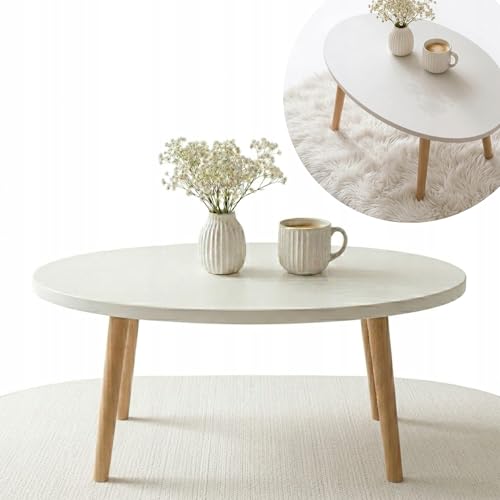
P&P Furniture Table basse blanche ovale 70 x 50 cm en bois scandinave
50 x 70 x 47 cm · Oval : 50 X 70 Cm
70 cm by 50 cm, an oval in Oval : 50 X 70 Cm wood that softens the angles where the other models on this page stay square or round. At 47 cm, it lines up with a low sofa, without exceeding the expected height of a Japandi table. Its oval shape, less common, does make matching a rug trickier: measure the width of yours before settling on this particular model, or risk a visible mismatch between the two shapes.
We watch the tables on this page for you. One email when one of them drops, nothing else.
As an Amazon Associate, we earn from qualifying purchases. The product links on this page may earn us a commission if you buy something — at no extra cost to you. Prices shown may have changed since we last checked.
Written by the Tavolia Bassio team
We don't test the furniture: we record each piece's measurements one by one and say where our figures come from. When a dimension is missing from a listing, we say so instead of guessing. Our method.

![[en.casa] Table Basse avec Portes Coulissantes et Compartiments de Rangement Table d'Appoint Massif Intemporel](https://m.media-amazon.com/images/I/51ACvH3rOXL._SL160_.jpg)

![[en.casa] Table Basse de Salon avec Plateau Rond Table d'Appoint Style Intemporel Bout de Canapé pour Salle de](https://m.media-amazon.com/images/I/418INl1o8FL._SL500_.jpg)

![[en.casa] Table Basse avec Portes Coulissantes et Compartiments de Rangement Table d'Appoint Massif Intemporel](https://m.media-amazon.com/images/I/51ACvH3rOXL._SL500_.jpg)