Oak holds a place apart among living-room timbers: harder than pine or beech, it stands up better to everyday knocks and develops a golden patina that improves with age rather than simply wearing down. That hardness comes at a price, literally: a solid oak table almost always costs more than an equivalent in pine or oak-effect veneered MDF, which only has the look of it. The six models on this page mix solid oak, oak veneer and oak-effect melamine, along with lift-top mechanisms that come up often with this particular material. Enough to work out what, in each listing, is genuinely oak and what only borrows the name. The dedicated oak coffee table range narrows things down further.
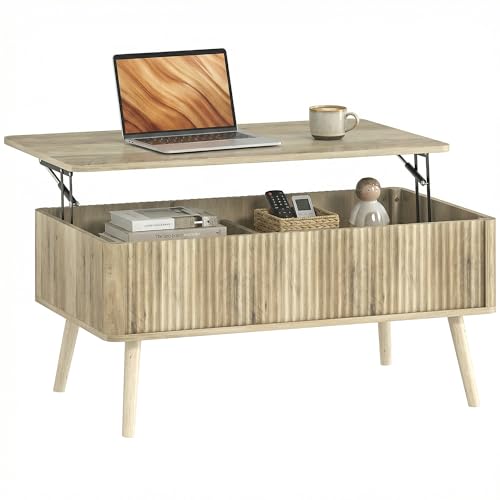
At 100 cm long and 50 cm deep, a lift-top that rises above a 45 cm base: Hzuaneri pairs a smooth pneumatic lift system with a White - Oak finish. The table turns into a workstation or an occasional dining table with no real effort needed to raise the top. The pneumatic mechanism stays gentler than a manual ratchet system, but it also ages: after several years of heavy use, the gas strut can lose firmness and drop back down faster than it should.
defiPad offers a round top here in a sturdy panel, 68 cm across and 47 cm high, with a second White and Oak level that serves as a storage shelf. The two-tier build stays stable even loaded, with no moving mechanism to maintain, unlike the previous lift-top model. Its round, compact shape suits a medium-sized living room, though it offers less surface space on top than a rectangle taking up the same diameter on the floor.
HOMCOM Table Basse Relevable 2 Compartiments Cachés 91 x 56 x 43 cm Ch
91L x 56l x 43H cm · Oak
A top measuring 91 cm by 56 cm that rises up to 43 cm from its low position: HOMCOM hides two large closed storage compartments under this Oak lift-top, more generous than the single-compartment system of the first model. The hidden double storage swallows books and magazines without them poking out once the top is raised. Two compartments side by side, in return, need a wider table on the floor than a model with just one enclosed space.
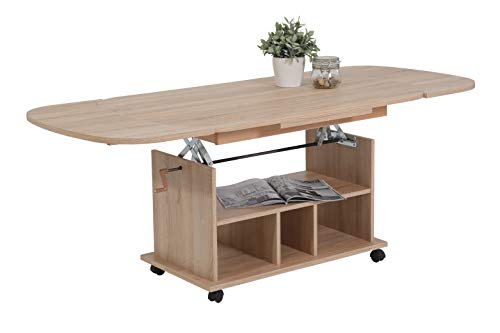
Oval, set on castors or on gas-lift legs depending on your choice, this SIMMOB table in Oak takes a different approach from the previous three models: it moves with a simple push rather than staying fixed in the same spot in the living room. The castors make it easy to tuck against a wall after use, a real plus in a small room used for several purposes. Reckon on around £140 for this model. The trade-off of castors: they can mark a fragile parquet floor slightly if the table is shoved rather than lifted.
100 cm long, 50 cm deep and 45 cm high: Manora goes for a classic Scandinavian style in Oak, with no sharp corners or edges, plus a closed cupboard that provides discreet storage. The absence of sharp corners limits knocks to legs passing near the table, a useful detail in a busy living room. The closed cupboard, handy for hiding clutter, stays smaller than the double compartment on the HOMCOM lift-top model on this page.
The top reaches 107 cm long, 67 cm deep, for 53 cm high: Hela Tische uses a wood-derived material with a Oak Sonoma melamine coating, a finish that copies oak without being oak. The top extends with side leaves, a feature no other model on this page offers. Melamine holds up well against everyday surface scratches, better than a real varnished solid oak top, but it can't be sanded to erase a deep mark the way genuine wood allows.
On the hardness scale of timbers used in furniture-making, oak ranks well above pine or fir, and slightly above beech. Hardness alone doesn't settle the choice of finish, so our pick between two popular finishes weighs oak against a stone-look surface too. That same resistance to marks and dents runs across the whole family, and one-piece wooden tabletops show it beyond oak alone. In practical terms, that means fewer marks left by a glass set down without care, and screws that hold better over time, particularly on lift-top mechanisms that put strain on the wood with every use.
That hardness has a downside: solid oak costs more to buy than pine or beech, and it also weighs more, a factor worth considering if the table needs moving often.
Frame material decides how oak compares to metal, but layout flexibility is a separate story, one this rearrangeable table set tells well. Oak's grain, more pronounced than beech's, also gives a bolder look, one some people seek out and others prefer to avoid in favour of a more understated grain.
Key point Oak's grain, more pronounced than beech's, also gives a bolder look, one some people seek out and others prefer to avoid in favour of a more understated grain.
Solid oak, oak veneer, or simple oak effect
Three levels of authenticity hide behind the word "oak" in product listings: solid, cut from the material itself; veneer, a thin sheet of real oak glued onto a panel; and "oak effect" or melamine, a printed pattern that only has the look of it. These three levels of authenticity behave very differently under a set of keys, as our guide to a coffee table that resists scratches makes clear.
The last model on this page illustrates that third case well: its melamine surface reproduces oak's grain convincingly in a photo, without any of the mechanical qualities of real wood.
To work out which of the three you're buying, look for the manufacturer's exact wording: "solid oak" commits to the material, "oak finish" or "oak effect" commit only to the look.
Key point To work out which of the three you're buying, look for the manufacturer's exact wording: "solid oak" commits to the material, "oak finish" or "oak effect" commit only to the look.
Upkeep and scratches: what oak forgives
Varnished solid oak copes reasonably well with everyday minor scratches: the wood's fairly dark natural shade hides a fine mark better than a white or very pale finish. A deeper knock, though, stays visible and needs local sanding followed by fresh varnish.
Oak veneer behaves differently: a surface scratch goes unnoticed, but a knock that goes through the thin wood layer exposes the pale panel underneath, a trickier repair than a straightforward sanding job.
Either way, a dry cloth day to day and a wood-care product once or twice a year are enough to keep the original look for several years.
Key point Either way, a dry cloth day to day and a wood-care product once or twice a year are enough to keep the original look for several years.
Lift-top mechanisms: why they come up so often in oak
Two of the six models on this page combine oak with a lift-top, a pairing that comes up often on this particular shelf. The reason is robustness: solid oak or its veneer copes better with a mechanism's repeated movements than softer materials, without marking as quickly at the friction points.
An oak lift-top still needs the same care as any other: never force the mechanism sideways, and check the stated maximum load before setting a full meal on it in the raised position.
For a long, narrow waiting area instead, our selection of squared-off designs handles daily knocks just as well. The hidden double compartment, present on one of the two lift-top models, also benefits from oak's rigidity to stay stable even loaded, without sagging under the weight of items stored inside.
Key point The hidden double compartment, present on one of the two lift-top models, also benefits from oak's rigidity to stay stable even loaded, without sagging under the weight of items stored inside.
Oak budgets: where the extra cost goes
A solid oak table costs more on average than an equivalent in pine, beech or oak-effect melamine, a gap that reflects the price of the raw material and the extra difficulty of working a harder wood.
If oak feels like too much upkeep, a walnut coffee table is worth comparing. That extra cost mainly pays off if you plan to keep the table a long time: solid oak can be sanded and restored, while oak-effect melamine gets replaced entirely once badly damaged, with no option for a local repair.
Key point That extra cost mainly pays off if you plan to keep the table a long time: solid oak can be sanded and restored, while oak-effect melamine gets replaced entirely once badly damaged, with no option for a local repair.
Light oak, dark oak: a matter of finish, not timber type
Raw oak has a fairly light, almost blonde shade. The deeper tones often seen on coffee tables — honey, smoked, or near-black — come from a stain or a coloured varnish applied after cutting, not from a different variety of oak.
That distinction matters for upkeep: a dark shade achieved with varnish hides everyday marks better than a light finish, which shows up every scratch against a pale background. In exchange, touching up a stained oak finish means matching that exact shade again, a trickier job than sanding followed by a natural oil on light wood.
Smoked oak, produced by a chemical process that naturally darkens the wood's tannins rather than by a surface coating, often holds up better over time than a simple stain: the colour sits in the material itself, not just on the surface, so a surface scratch doesn't reveal lighter wood underneath.
Before buying on a photo alone, keep in mind that a shoot's lighting changes how a wood shade looks a great deal: an oak that looks very dark in a photo can seem noticeably more golden once it's in your living room, under different light.
A good habit before ordering: look at several photos of the same product, taken from different angles and under different light, rather than trusting a single featured image. Some sellers lightly retouch their visuals to make the shade look consistent across a range; cross-checking several shots gets you closer to the real result once the piece is installed at home, under your own lighting rather than a professional photo studio's.
If the seller offers a material sample before you buy, don't hesitate to ask for one: a small piece of oak placed at home, under your own light and next to your other furniture, remains the most reliable way to judge a shade, far more so than any number of carefully taken photos. This option is still rare on this type of furniture sold online, but it does exist with some manufacturers for larger orders.
Key point This option is still rare on this type of furniture sold online, but it does exist with some manufacturers for larger orders.
Oak to suit your living room's style
In a classic or country-style living room, solid oak remains a safe bet: its natural shade and pronounced grain sit well with older wooden furniture, without ever clashing with a room that's been furnished for a while.
For a more contemporary living room, dark or smoked oak, paired with a slim black metal frame, fits better than light solid oak, which can visually weigh down a room already busy with furniture.
In a Scandinavian-style room, light oak stays coherent as long as the lines stay simple, with no ornament or moulding: that's exactly the choice made by the most pared-back model on this page, with no sharp corners or edges.
Key point In a Scandinavian-style room.
Oak, beech, pine: which to choose depending on how you'll use it
Beech offers an interesting middle ground between oak's hardness and pine's more accessible budget, with a finer grain than both. It suits a living room that sees everyday use without regular heavy knocks.
Pine remains the softest of the three, so the most prone to marks, but also the easiest to repair yourself with simple local sanding. It's often the best choice for a first living room on a tight budget.
A travertine coffee table offers a different kind of durability if stone appeals more than wood. Oak, pricier and heavier, is worth it mainly if the table needs to last several years without weakening, or if it might one day be passed on from one living room to another during a house move, something a softer wood copes with less well over time.
Worth knowing
Frequently asked questions
Is solid oak really stronger than other timbers?
Yes, on the hardness scale of timbers used in furniture-making, it ranks above pine, fir and slightly above beech. In practice that mainly means fewer marks left by an everyday light knock.
How do I tell real oak apart from a simple melamine oak effect?
Look at the price and the exact description: 'solid oak' commits to the material, 'oak effect' or 'melamine' commit only to the look. To the touch, real wood keeps a slight grain, while melamine stays perfectly smooth.
Does dark oak hide scratches better than light oak?
Yes, to some extent: a deep shade hides a fine mark better than a pale background. Smoked oak, whose colour sits in the material rather than just on the surface, also resists a surface scratch better than a simple stain applied on top.
Does oak suit a living room with pets?
Yes, its hardness copes well with light scratches from a cat or knocks from a dog playing nearby. A harder knock stays visible, but local sanding is usually enough to remove it from varnished solid oak.
Does oak need treating against insects?
Solid oak meant for indoor furniture already gets factory treatment, so there's no need to add your own. This mainly concerns raw wood used outdoors, rarely finished living-room furniture.
Does oak fade in sunlight?
Yes, like most natural woods: direct, prolonged exposure lightens the shade slightly over time. A curtain or net in front of the most exposed window limits this over the long run.
Can a solid oak table be passed on from one house move to the next?
That's precisely one of solid oak's strengths: it can be sanded and restored, unlike a veneer or melamine top, which can't be repaired in the same way. A well looked-after table can go through several homes without losing its purpose.
Is a solid oak table heavier to move than a veneered one?
Yes, noticeably: solid wood carries the real weight of the timber, while a veneer sits on a lighter panel. Plan on having two people move a large solid top, especially on a narrow staircase.
Price alert
Tell me when the price drops
We watch the tables on this page for you. One email when one of them drops, nothing else.
As an Amazon Associate, we earn from qualifying purchases. The product links on this page may earn us a commission if you buy something — at no extra cost to you. Prices shown may have changed since we last checked.
Written by the Tavolia Bassio team
We don't test the furniture: we record each piece's measurements one by one and say where our figures come from. When a dimension is missing from a listing, we say so instead of guessing. Our method.


 Manora Table Basse Bois
 Hzuaneri Table Basse, Table de Salon R
 SIMMOB Table Basse Ovale