A bunch of keys dropped without thinking, a toy dragged across the top, a cat's claws as it jumps up: a scratch never gives you warning. Solid wood copes with this kind of contact far better than a glass or high-gloss lacquered top, which shows the faintest mark under the light. Brushed metal, on the other hand, naturally hides small marks in its grain rather than showing them off like a smooth surface would. The five tables here rely on different materials and finishes when it comes to this everyday risk, each with its own way of absorbing or revealing wear. The dedicated glass tabletop lineup range is worth a look if you're weighing that trade-off directly.
Which one to choose, based on your living room
If budget is the deciding factor
IDMarket, Table Basse Ronde Alix Pied araignée 70 cm Bois et Noir
A textured or grained top, in real wood or wood-effect veneer, hides a small scratch better than a smooth, plain surface: the eye doesn't catch as easily on a fine line in the middle of a busy pattern. That same trade-off between forgiving texture and telltale smoothness runs through the timber-or-glass question more broadly.
Glass, glossy lacquer and polished metal do the opposite, showing up every mark under low light even when the scratch itself is only superficial. It isn't always a flaw in the material, more an optical effect tied to how glossy the surface is.
A travertine coffee table handles everyday knocks in a similar forgiving way. Solid wood keeps an edge over time: a deep scratch can be sanded and re-oiled in that one spot, which a veneer or laminated panel can't offer — once the top layer is broken, the mark stays visible.
Key point Solid wood keeps an edge over time: a deep scratch can be sanded and re-oiled in that one spot, which a veneer or laminated panel can't offer — once the top layer is broken, the mark stays visible.
Preventing rather than repairing
A set of coasters or pads, used consistently, stops direct contact between a metal base or vase foot and the top. It's the simplest habit, and the one most often forgotten once the table is in place. Some surfaces forgive a forgotten coaster better than others, and the marble-effect or glass comparison shows which top survives daily life best.
In a home with a pet, choosing a textured top or a darker shade reduces how visible a cat's small scratches are compared with a smooth, light surface.
Self-adhesive felt pads under each leg also protect the floor: a scratch doesn't just affect the top, it marks the wood or tiles just as much if the table slides while being moved.
Key point Self-adhesive felt pads under each leg also protect the floor: a scratch doesn't just affect the top, it marks the wood or tiles just as much if the table slides while being moved.
When the mark is already there
On solid wood, a light local sanding followed by a suitable oil or wax removes most surface marks without redoing the whole surface. Repairing a mark is easier on some tops than others, so read the marble-effect or tempered glass comparison before committing to a surface.
On a lacquered or MDF top, a fine scratch can sometimes be hidden with a touch-up pen close to the original shade — a cosmetic fix rather than a real repair.
On metal, a bit of furniture wax restores some shine around a small mark and reduces the risk of rust taking hold where the protective coating has been broken.
Key point On metal, a bit of furniture wax restores some shine around a small mark and reduces the risk of rust taking hold where the protective coating has been broken.
The role of varnish and surface treatment
A matte varnish tinted right through marks less visibly than a glossy one applied on the surface: the scratch cuts into the same thickness of material, but it shows less on a finish that doesn't rely on reflections.
An anti-scratch treatment, sometimes mentioned on glass or ceramic tops, adds a layer of extra hardness without changing the look of the original material — a real plus if the budget allows.
This kind of hardy top also suits a coffee table for a waiting room. On a solid wood top, a penetrating oil protects better over time than a simple surface varnish, because it feeds the wood grain rather than just forming a film that wears away.
Key point On a solid wood top, a penetrating oil protects better over time than a simple surface varnish, because it feeds the wood grain rather than just forming a film that wears away.
Everyday life with children and objects left lying around
A construction toy dragged across the top remains the most common cause of scratches in a family living room, well ahead of a one-off knock or a piece of furniture being moved.
A tablecloth or throw left permanently over a play area protects an exposed top effectively, without needing to cover the whole table outside those moments.
A coffee table for a cosy living room often shares that same everyday wear-and-tear concern. Teaching a child to place rather than slide an object stays the simplest habit to pass on, and the one that prevents the most marks over time, whatever material is chosen.
Key point Teaching a child to place rather than slide an object stays the simplest habit to pass on, and the one that prevents the most marks over time, whatever material is chosen.
Cleaning without adding scratches
A clean microfibre cloth limits the risk of adding a new mark while cleaning: a cloth already carrying dust or fine grit acts as a mild abrasive with every pass over the top.
Vacuuming or dusting before wiping with a damp cloth avoids spreading the hardest particles, often invisible to the eye, that cause most micro-scratches.
Moving the table, even slightly, is best done by lifting rather than sliding it across the floor: this protects the table's legs as much as the parquet or tiles beneath. Storing small sharp-edged objects, like a keyring or a metal toy, in a drawer rather than on the top also cuts down on the direct contact likely to leave a mark over the weeks — a habit that also keeps the top clearer day to day and makes it much easier to wipe the whole surface without moving a dozen small objects each time.
Key point Storing small sharp-edged objects.
The detail, product by product
IDMarket, Lot de 2 Tables Basses gigognes Hawkins Rondes Bois foncé
54 cm x 54 cm x 35.5 cm, 70 cm x 70 cm x 46 cm · Wood Antique (Top de Table), Black (Legs and Base)
70 cm by 54 cm for the larger of this Wood Antique (Top de Table), Black (Legs and Base) nesting pair by IDMarket. The dark wood top hides a small mark far better than a light finish, where every scratch stands out by contrast. At 35.5 cm for the smaller of the two. Its limit: the black metal legs, on the other hand, show a scratch's shine much faster than the wood top does.
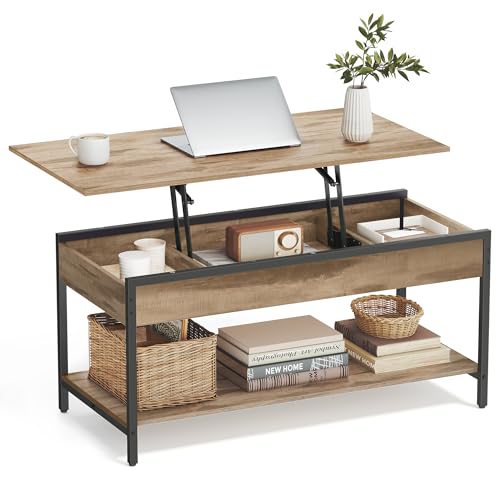
100 cm wide for this Brown Camel + Black D’ink top by VASAGLE, brown panels on black legs with an industrial look. The deliberately raw finish of the brown panel hides a small mark better than a smooth lacquered one. At 50 cm for the lift-top when raised. Its limit: the lift mechanism, sliding with every use, ends up marking the metal rails that guide it — a point worth watching more than the top itself.
80 cm across, a Brown Rustic + Black Matte half-moon lift-top by VASAGLE, industrial style. The hidden compartment under the top keeps out of sight the objects that, once taken out and set on top, would end up scratching it with repeated handling. At 45 cm high. Its limit: the metal rim around the lift-top chips faster than the panel above it once exposed to repeated knocks.
IDMarket, Table Basse Ronde Alix Pied araignée 70 cm Bois et Noir
70 cm x 70 cm x 40,5 cm · Beige
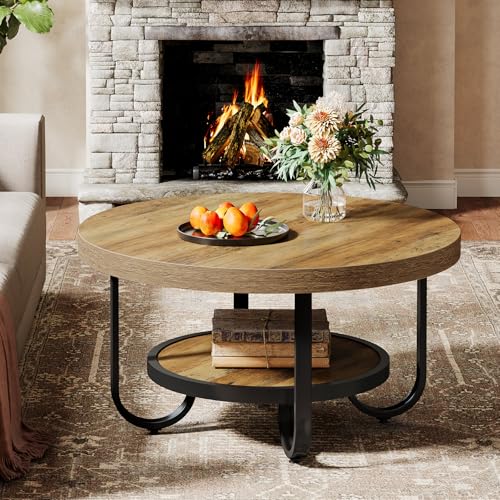
70 cm across for this Beige top on a spider-leg base by IDMarket, wood and black metal. The central metal leg, unlike a wood top, barely scratches when objects are moved across it. At 40.5 cm. Its limit: the wood top itself stays exposed like any wood table — a felt pad under each item set down limits the build-up of tiny marks.
79 cm across, a two-tier table in MDF with wood-grain veneer by Tribesigns, Brown. The veneer copies the texture of wood, which hides a fine scratch better than the flat, uniform finish of a plain panel table. At 45 cm. Its limit: a veneer, unlike solid wood, can't be sanded down to remove a deep mark — once the surface is broken, it can't be repaired.
We watch the tables on this page for you. One email when one of them drops, nothing else.
As an Amazon Associate, we earn from qualifying purchases. The product links on this page may earn us a commission if you buy something — at no extra cost to you. Prices shown may have changed since we last checked.
Written by the Tavolia Bassio team
We don't test the furniture: we record each piece's measurements one by one and say where our figures come from. When a dimension is missing from a listing, we say so instead of guessing. Our method.