Genuine walnut has a grain that varies from one plank to the next; a 'walnut-effect' finish on MDF or melamine repeats that grain identically across the whole surface, without the natural variation you get with solid wood. That's not a hidden flaw — it's what keeps these tables affordable rather than priced like a made-to-measure cabinetmaker's piece. Weight is often the first clue before you've even touched the top: a model noticeably lighter than the rest almost always hides a hollow panel behind an attractive photo. Six models make up this selection, from a plain fixed coffee table to a lift-top version that turns into a full dining table for an impromptu meal, each with its own way of imitating or embracing that warm brown wood so sought-after in Scandinavian-style living rooms. Two of them go further still than a simple fixed coffee table, with a lift mechanism that turns the top into a full dining surface for a spontaneous dinner without leaving the sofa, a use neither solid wood nor standard veneer usually offers without this extra mechanism built in from the start.
A closer look at each model
VOWNER Table Basse Relevable Extensible Table à Manger
108P x 105l x 68H CM · Walnut
This lift-top table measures 108 cm by 105 cm. At rest, it sits at sofa height; the top then lifts to become a full dining table for the length of a meal. The metal gas-lift strut makes raising the top easy with no strain on the arms. This lifting mechanism, handy day to day for eating in front of a film, is still a wear point worth keeping an eye on over time, unlike a plain fixed leg, which never moves and needs no mechanical upkeep over the years. Once raised, it easily seats two people on tall stools, a real space-saver in a studio flat with no fixed spot for a standard dining table.
VOWNER Table Basse Relevable Extensible Table à Manger Noyer
108P x 105l x 66H CM · Walnut
This model shares the same lift-top principle as its close relative, at 108 cm by 105 cm: flat, it sits at sofa height; fully raised, it reaches dining-table height, with a gas-lift strut described as sturdier than a simple spring-loaded one. The exact height in the raised position is worth checking closely when ordering if you also plan to use it occasionally as a desk, or your knees risk knocking against the underside once seated.
The round top measures 100 cm by 100 cm, with angled tapered legs that visually lighten the whole table's silhouette. At 45 cm, it suits a standard sofa without rising above the seat. The warm walnut finish does mark from water rings if a damp glass sits too long with no coaster, as most light-wood finishes do, unlike a lacquered or sealed top, which copes far better with this kind of common household mishap.
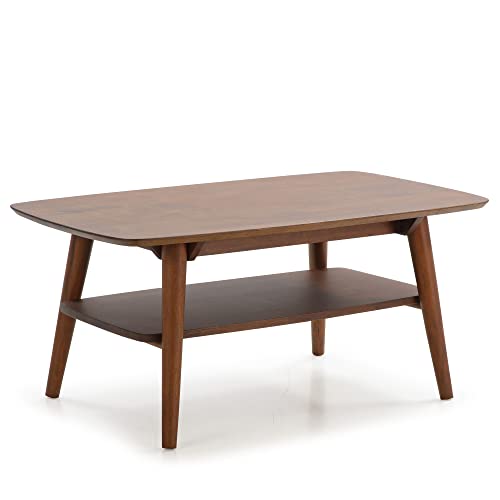
HOMN LIVING Table Basse Palma 1 Trou Couleur Noyer
100 x 60 x 45 cm · Walnut
This solid-wood table spans 100 cm in width and 60 cm in depth, with 45 cm of clearance underneath, plus a lower storage opening matched to the overall walnut shade. Solid wood takes small knocks better than a light veneer, but its weight makes itself felt when moving it alone to vacuum underneath, unlike the lighter models on this page, which lift with one hand and no real effort.
This round top reaches 78 cm across and 43 cm high, arranged over two levels with storage space under the main top for magazines. The Scandinavian style suits a small, bright living room well. With no separate depth given by the manufacturer, rely on the diameter alone to check the floor space needed before ordering: a round model never takes up space in quite the same way as a rectangle with the same measurements on paper.
Solid wood is worked as one thick piece and costs more to produce; veneer or a walnut-effect finish applies a thin layer or a print onto an MDF panel, which is lighter and far more affordable for most family budgets. Veneer keeps the walnut look at a lower cost, and the marble-inspired range applies that same printed-finish logic to stone patterns instead. Walnut is only one species among several worth considering, so browse the wider wooden coffee table range before you lock yourself into a single grain and tone.
Both are cleaned the same way, with a lightly damp cloth used regularly. Above all, check the weight given by the manufacturer in the specifications: a clear gap between two similarly sized models almost always gives away the real material used underneath.
Key point Above all, check the weight given by the manufacturer in the specifications: a clear gap between two similarly sized models almost always gives away the real material used underneath.
What a lift-top table is actually for
The lift mechanism turns a coffee table into a full work or dining surface, genuinely useful in a studio flat with no fixed spot set aside for a standard dining table in the main room. A working surface takes daily abuse, so our comparison of marble-effect or tempered glass is worth reading before choosing that top. Studio flats often want warmth on a budget too, and the solid pine coffee table page covers the lightest wood option available.
The gas-lift strut carrying the top is a mechanical part like any other: avoid leaving something heavy on it in the lowered position for weeks on end, which wears the mechanism out far faster than occasional use.
Key point The gas-lift strut carrying the top is a mechanical part like any other: avoid leaving something heavy on it in the lowered position for weeks on end, which wears the mechanism out far faster than occasional use.
Does brown suit every floor?
A light wooden floor shows off a dark walnut top by contrast, while an already dark floor can feel a little heavy if the rest of the furniture also stays in similar brown tones with no visual break. If a dark floor rules out brown tones, our comparison of oak or metal offers two ways to break that visual heaviness. Colour aside, a dark top also meets hot mugs daily: our guide to a coffee table that doesn't mind heat covers that side.
A pale rug under the table breaks up that continuity and brings light back to the whole room, a simple move that works just as well with solid wood as with a printed walnut-effect finish on MDF.
Key point A pale rug under the table breaks up that continuity and brings light back to the whole room, a simple move that works just as well with solid wood as with a printed walnut-effect finish on MDF.
Looking after a walnut top without damaging it
Solid wood takes a nourishing wax or oil once or twice a year, something veneer or MDF never needs, since their surface finish doesn't feed the same way genuine wood fibre exposed to the room's air does. If yearly oiling sounds like a chore, our comparison of metal or steel covers frames that ask for nothing but a cloth.
Still, avoid setting anything hot directly on either kind of top: solid or veneered, walnut marks under the heat of a dish straight from the oven with no protective mat set down first.
One more useful pointer for choosing between the six models: the lift mechanism, found on two of them, adds real everyday usefulness, but remains one more moving part to maintain than a plain fixed top on ordinary legs.
Walnut grain, whether solid or printed, pairs naturally with a wool or jute rug rather than a very synthetic, glossy one, a combination of materials that reinforces the warm feel most buyers are after with this particular brown wood tone.
One last thing before wrapping up: always compare the listed weight between two similarly sized tables. A clear gap, at the same size, almost always gives away the difference between a solid top and a veneered one — that figure in kilos is a far more reliable clue than any photo on the seller's listing when it comes to guessing the real material underneath.
We watch the tables on this page for you. One email when one of them drops, nothing else.
As an Amazon Associate, we earn from qualifying purchases. The product links on this page may earn us a commission if you buy something — at no extra cost to you. Prices shown may have changed since we last checked.
Written by the Tavolia Bassio team
We don't test the furniture: we record each piece's measurements one by one and say where our figures come from. When a dimension is missing from a listing, we say so instead of guessing. Our method.



 Manora Table Basse Ronde Bois
 HOMN LIVING Table Basse Palma 1 Trou C
 Tribesigns Table Basse Ronde
 VOWNER Table Basse Relevable Extensibl
 VOWNER Table Basse Relevable Extensibl