HomeMaterialWood or Metal: Which Coffee Table Should You Choose?
Material
Wood or Metal: Which Coffee Table Should You Choose?
Wood absorbs the light in a living room, metal reflects it back: that's often the first thing that separates the two camps, even before style. A metal frame takes everyday knocks without a mark, while a wood top dents at the first careless shove from a sofa. Wood, in return, doesn't fear scratches from a key set down too quickly, unlike lacquered metal, which holds on to every scuff. The choice isn't just about looks: weight, upkeep and resistance to children or pets all weigh just as heavily in the decision. Four models, two camps, to choose based on what your living room already struggles with, rather than on the photo that first caught your eye. Beyond these four, browse the full range of wooden table models and metal coffee tables to compare more options.
This WLIVE nesting pair in Brown relies on thin metal legs that give it an industrial silhouette, with a reinforced particle-board top. The two tables slot one under the other, handy for a living room short on space or for hosting, splitting the two surfaces for the length of drinks with friends. Their drawback: the listing gives no measurements for this model, unlike the other three on this page — measure your space yourself before ordering, especially the height, which decides whether the pair lines up with your sofa.
70 cm across for this round HOMERECOMMEND table in Black, carried on semi-circular metal legs that keep the view clear underneath the top. At 48 cm, it settles easily in front of a low sofa without rising above seat level. The metal camp wins on visual stability here, but such an open frame doesn't cushion a knee bumping into it sideways very well: keep a clear path around it, especially if young children run about the room.
IDMarket, Table Basse Plateau relevable en Table à Manger ELEA Noir/Bo
100 cm x 50 cm x 42,5 cm · Black
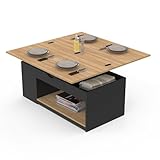
100 cm by 50 cm in Black, this IDMarket lift-top goes from coffee table to dining table in one move, something metal alone never offers. Wood covers the top while a sturdier structure carries the lift mechanism, built for an impromptu meal in front of the television or a spot of occasional work. At 42.5 cm at rest, it sits at the lower end of the range. This handy mechanism adds play in the hinges over the years: a point worth checking after several months of heavy use.
90 cm by 60 cm, a Willonin Scandinavian-style coffee table in White that bets entirely on wood: a solid top and a matching low shelf, with no metal parts on show at all. At 40 cm, it stays clearly below the level of a standard sofa seat, reassuring if you're keen not to go above the usual height. The wood camp wins on warmth of material, but its slim legs scratch more easily on a hard floor than the often-reinforced legs of the metal camp: fit pads before sliding it into place.
A solid or veneered wood top brings a warmth metal never fully copies, even varnished in a matching tone. A third material brings its own warmth without wood's upkeep, and the woven-fibre section shows what that looks like. It's the material that ages best visually: a small scratch on wood can be sanded or repainted, while a knock mark on lacquered metal chips and stays visible. A third material sits between the two, reviewed on the best glass coffee table page for rooms that need visual lightness.
In exchange, wood dislikes standing damp: a glass set down with no mat can leave a ring on some finishes, especially on an untreated matt top. Wipe up any spill as soon as it happens rather than letting it dry.
Wood also works well in a room already full of metal — window frames, lighting, handles: it brings a bit of warm material back down to floor level, where the eye lands first on entering the room.
Key point Wood also works well in a room already full of metal — window frames, lighting, handles: it brings a bit of warm material back down to floor level, where the eye lands first on entering the room.
What metal changes in your living room
A metal frame copes better with everyday knocks than a thin wooden leg: a bump from the vacuum or a knee catching the table leaves no mark, unlike a wooden edge, which dents. That's a real plus in a busy living room, with children or a sofa moved often. For knock resistance with a dressier surface on top, the best marble-effect coffee table page is the natural next stop.
The trade-off: lacquered metal shows fingerprints and dust more visibly than matt wood, especially in dark shades. A dry cloth is enough, but it needs bringing out more often than for a wood top.
Also check the weight: an all-metal frame is generally lighter than a solid wood top, which makes the odd move easier but leaves the table more sensitive if knocked from the side.
Key point Also check the weight: an all-metal frame is generally lighter than a solid wood top, which makes the odd move easier but leaves the table more sensitive if knocked from the side.
Based on your sofa and your style
The rule stays the same whatever the material: the coffee table top should sit level with the seat or slightly below it, never above. On a standard sofa seat, at 45 to 60 cm, a table taller than that makes it awkward to set down a glass. With the height settled, the material question returns, and the best oak coffee table page shortlists the warmest wood options.
For length, aim for around two-thirds of your sofa: a table too short looks lost in front of a three-seater, one too long eats into the walkway. Leave 40 to 50 cm of clearance between the edge of the table and the seat, so you can move around without catching a leg every time you pass.
On style, a Scandinavian or Japandi living room naturally leans towards light wood; an industrial or loft-style room leans towards black or raw metal. There's nothing stopping you mixing the two in the same room, as long as one material clearly dominates so you don't stack up contrasts.
Key point There's nothing stopping you mixing the two in the same room, as long as one material clearly dominates so you don't stack up contrasts.
The verdict, case by case
A living room with young children or heavy footfall does better with metal: fewer visible marks, quicker everyday cleaning. A quiet living room, where the coffee table mainly holds a book or a cup, gets more out of the warmth of wood. Once the material is settled, the marble-effect or MDF coffee table comparison tells you which top holds up best to cups and daily wiping.
If you often host guests and turn your coffee table into an extra dining surface, a lift mechanism takes priority over the simple wood-versus-metal choice: check the stated weight limit before setting a dish on it.
If in doubt, measure your sofa and the space around it first: material matters less than size — a beautiful, badly sized coffee table stays uncomfortable whatever it's made of.
Key point If in doubt, measure your sofa and the space around it first: material matters less than size — a beautiful, badly sized coffee table stays uncomfortable whatever it's made of.
What to check before you pay
Before comparing wood and metal on paper, check exactly what the panel is made of: a melamine particle-board panel doesn't repair like solid wood, even if it looks the part in the photo. The product listing usually states this detail, often in the technical specifications rather than the title.
Also check whether the metal legs are screwed or welded: screwed legs can be tightened again easily after a few years of use, welded legs can't be repaired if they work loose. This detail doesn't show up in a photo, but it changes how long the table really lasts once it's in your living room.
Key point This detail doesn't show up in a photo, but it changes how long the table really lasts once it's in your living room.
Combining wood and metal in the same table
Some models don't really pick a side: a wood top set on a metal frame combines both materials rather than choosing one. It's often the simplest compromise if the living room already mixes the two elsewhere, in a shelf frame or an industrial-style sofa.
This mix still calls for checking the join between the two materials: a poorly tightened fixing between the wood top and the metal frame ends up creaking faster than a single-material structure, especially if the table is often used as support to get up. A turn of the screwdriver once a year is usually enough to avoid this.
The visual contrast between the two materials also stands out differently depending on the shade chosen: light wood on black metal marks the contrast more than dark wood on gold metal, which sits closer in tone. Something worth bearing in mind in front of an online shop screen, where colours never render exactly as they do in real life. Ask for a photo taken in natural light rather than a studio shot, if possible, before making your final choice.
Key point Ask for a photo taken in natural light rather than a studio shot, if possible, before making your final choice.
Price alert
Tell me when the price drops
We watch the tables on this page for you. One email when one of them drops, nothing else.
As an Amazon Associate, we earn from qualifying purchases. The product links on this page may earn us a commission if you buy something — at no extra cost to you. Prices shown may have changed since we last checked.
Written by the Tavolia Bassio team
We don't test the furniture: we record each piece's measurements one by one and say where our figures come from. When a dimension is missing from a listing, we say so instead of guessing. Our method.


 WLIVE Table Basse Rondes


