An exposed brick wall already gives a living room plenty of character, and the coffee table needs to respond without fighting it or simply copying it. A black metal top extends the wall's industrial texture, faux marble adds a smoother note in contrast, and a travertine shade softens the whole look without breaking the raw feel. Five models built to pair with this wall rather than fade beside it, each with a drawback worth knowing. For more pieces that hold their own against a strong feature wall, check our design coffee table lineup.
An exposed brick wall already carries enough texture and colour without needing a second equally busy piece in the room. To let an exposed brick wall stay the room's focus, our guide to industrial styling covers exactly which finishes work. A plain top, in light wood, faux marble or matte black metal, lets the wall stay the room's focal point. A raw wall suits two closely related styles, set against each other on the industrial or rustic coffee table page.
A busy pattern on the table competes with the brick rather than complementing it: that's often what makes a raw-style living room feel visually cluttered.
Key point A busy pattern on the table competes with the brick rather than complementing it: that's often what makes a raw-style living room feel visually cluttered.
Metal, marble or wood: three ways to pair with the wall
Black metal directly extends the industrial texture of a brick wall, staying in the same raw register. Faux marble, by contrast, brings a smoother, more polished contrast that softens the look without contradicting it.
A modern coffee table in black metal follows that same industrial line most directly. Raw wood, somewhere between the two, warms up a room where brick and metal would otherwise dominate the eye completely.
Key point Raw wood, somewhere between the two, warms up a room where brick and metal would otherwise dominate the eye completely.
Height, independent of the wall's style
The wall doesn't change the basic rule: a coffee table shouldn't exceed 45 cm in height, to stay below a sofa seat that mostly sits between 45 and 60 cm. It's the same measurement in a raw-style room as in a classic one. The style still has to be chosen, and the industrial or Scandinavian coffee table comparison does that in a single page.
The five models on this page keep to this height: measure your sofa before ordering, as a low model sometimes sits below average.
Key point The five models on this page keep to this height: measure your sofa before ordering, as a low model sometimes sits below average.
A raw material needs different upkeep
A sintered-stone or faux-marble top holds up well against everyday marks and knocks, better than a glass one in the same room. A simple dry cloth is usually enough, no need for a strong product that would damage the finish over time.
A matte black metal top, on the other hand, shows fingerprints more visibly than stone: a regular wipe keeps the original matte look intact.
Key point A matte black metal top, on the other hand, shows fingerprints more visibly than stone: a regular wipe keeps the original matte look intact.
Low evening light on brick reshapes the piece
A brick wall, often lit at an angle in the evening, casts strong shadows that highlight the texture's relief. A very reflective top, such as a lacquered finish, bounces that light back differently depending on the time of day.
A matte top keeps a more consistent look throughout the day, which suits a living room better where lighting shifts a lot between day and evening.
Key point A matte top keeps a more consistent look throughout the day, which suits a living room better where lighting shifts a lot between day and evening.
A compact format, an option for a wall that already fills the space
A brick wall naturally draws the eye, which sometimes leaves less visual room for a large piece in the centre of the space. A smaller side table, placed near the sofa rather than in the middle of the room, keeps the balance.
The drawback of a compact format: it suits a reading corner or a spot beside the sofa, but doesn't replace a central coffee table if the room often has guests.
Key point The drawback of a compact format: it suits a reading corner or a spot beside the sofa, but doesn't replace a central coffee table if the room often has guests.
Side furniture around the wall, a balance to keep
A brick wall often pairs with open shelving or a bookcase, which already adds relief to the room. The coffee table doesn't then need extra texture: a plainer top lets the whole room breathe.
If the wall stays bare, with no shelf or frame, the table can carry a bit more character instead, so the brick isn't left carrying all the texture alone.
Key point If the wall stays bare, with no shelf or frame, the table can carry a bit more character instead, so the brick isn't left carrying all the texture alone.
A tight budget doesn't stop you pairing with exposed brick
A brick wall already gives the room plenty of character for free, leaving room for a simpler table without the living room looking visually poor.
A basic wood or metal model, without a costly finish, blends very well into a room already marked by brick, with no need to compete on material.
Key point A basic wood or metal model, without a costly finish, blends very well into a room already marked by brick, with no need to compete on material.
Brick, a wall that forgives small flaws in the furniture
An exposed brick wall, already irregular by nature, makes small imperfections on a secondhand or slightly worn piece less noticeable. It's a setting that tolerates a pre-loved table well without the room looking neglected.
Against exposed brick, this luxe golden surface creates a striking contrast that rustic wood can't quite match. In a living room with smooth, plain walls, the same worn table would stand out far more: brick offers a useful margin of tolerance here.
Key point In a living room with smooth, plain walls, the same worn table would stand out far more: brick offers a useful margin of tolerance here.
Contrasting shades rather than a perfect match
Looking for a table that exactly replicates the brick's colour rarely gives a good result: two surfaces close in colour but different in texture create visual confusion rather than harmony. A clear contrast works better than an approximate match.
A vintage coffee table often carries just that kind of bold, contrasting tone. A white, black or bold-coloured top contrasts clearly with brick, while a beige or light brown tone risks looking off beside it without ever blending in.
Key point A white, black or bold-coloured top contrasts clearly with brick, while a beige or light brown tone risks looking off beside it without ever blending in.
Seating furniture around it also matters for the overall balance
The coffee table never works alone against a brick wall: the sofa and armchairs around it play just as much a part in the room's overall balance. A textured fabric sofa pairs well with the wall's roughness, a smooth leather sofa creates more contrast.
Think of the table as one element among others rather than the sole piece responsible for pairing with the wall: the whole living room counts towards the final result.
Key point Think of the table as one element among others rather than the sole piece responsible for pairing with the wall: the whole living room counts towards the final result.
A brick wall doesn't lock you into one style era
Contrary to a common belief, a brick wall doesn't limit the choice to a strict industrial or vintage style. A very contemporary table, with clean lines, creates just as successful a contrast as a model that echoes the wall's raw codes.
The real risk is piling up too many strong references at once, brick, rusted metal and raw wood together, which ends up overloading the mood rather than enhancing it. Against exposed brick, this warm, grained hardwood softens the room without leaning fully rustic. Torn between two lighter styles instead?
Key point Torn between two lighter styles instead?
Our picks in detail
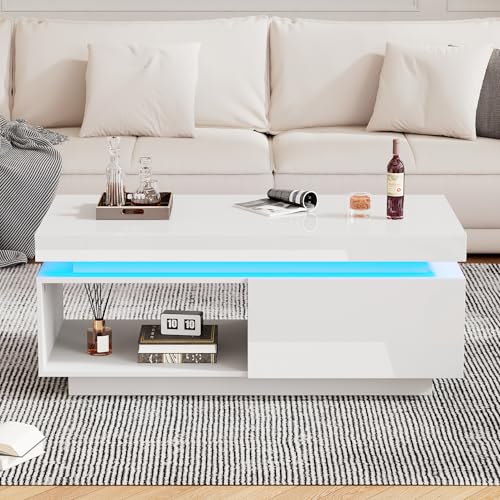
QSOST Table Basse Rectangulaire Haute Brillance LED
100*50*40CM · White
100 cm by 50 cm, a high-gloss white finish with two compartmentalised drawers, a sharp contrast against the rough texture of a brick wall. At 40 cm, it stays under a standard seat. The glossy finish, appealing at first, shows fingerprints faster than a matte one.
A coffee table in travertine-effect melamine, priced at around around £40, 18 mm thick, with wall-mounting possible. Its stone shade pairs with the grain of a brick wall without copying it. Melamine, though, doesn't replicate the natural grain of real stone to the touch.
FATIVO Table Basse Gigogne Marbre: Lot de 2 Tables Gigognes de Salon R
φ70/φ57 Pieds Doubles · White
70 cm and 40 cm for the larger table in a faux-marble nesting duo, an industrial-style frame that matches a raw wall. The set of two suits a living room short on side surfaces. Faux marble, despite its polished look, stays lighter and less cool to the touch than real stone.
90 cm by 50 cm, a marble-effect sintered-stone top on a metal frame, with an open shelf as a second tier. At 45.5 cm, it lines up with a typical sofa. Sintered stone holds up well to everyday knocks, but its weight makes the piece harder to move than a light wood top.
32 x 32 x 55 cm (L x l x H) · Vintage Brown, Black
55 cm tall for a round side table with two shelves, an industrial style that extends the texture of a brick wall. Its small size suits a reading corner or a spot beside the sofa rather than a central coffee table for the whole room.
We watch the tables on this page for you. One email when one of them drops, nothing else.
As an Amazon Associate, we earn from qualifying purchases. The product links on this page may earn us a commission if you buy something — at no extra cost to you. Prices shown may have changed since we last checked.
Written by the Tavolia Bassio team
We don't test the furniture: we record each piece's measurements one by one and say where our figures come from. When a dimension is missing from a listing, we say so instead of guessing. Our method.