HomeMaterialWhich Coffee Table for a Natural Look?
Material
Which Coffee Table for a Natural Look?
Natural style favours raw material over a flawless finish: wood that keeps its knots, a hand-woven fibre, a shade that varies slightly from one piece to the next. Five coffee tables that embrace these small irregularities rather than smoothing them away, for a living room that goes for simplicity over shine. Worth knowing upfront: these raw materials usually ask for more attention than a uniform lacquered top. A glass coffee table sits at the opposite end of that spectrum, if raw texture isn't really what you're after.
An untreated material, whether raw wood, cork or woven fibre, soaks up moisture and stains more readily than a varnished or lacquered surface. Travertine styling ideas offer that same warm, natural look without the staining risk of raw wood. That's the price of a warmer, less standardised look.
A coaster used consistently, plus a dry cloth after each use, is usually enough to keep these materials in good shape without resorting to a harsh cleaning product.
A wood or metal coffee table is worth a look too if you want that natural warmth with less upkeep. The five models on this page accept that trade-off in exchange for a look that no synthetic material truly replicates.
Key point The five models on this page accept that trade-off in exchange for a look that no synthetic material truly replicates.
Natural doesn't mean fragile
Some raw materials, such as reconstituted stone or dense wood, hold up just as well as a classic treated top, simply without the varnish that evens out the appearance.
A mango wood coffee table is a good example of a dense, sturdy natural material that still holds this raw look. The real thing to watch is direct sunlight, which can fade a natural fibre faster than a synthetic material treated against UV at the factory.
Key point The real thing to watch is direct sunlight, which can fade a natural fibre faster than a synthetic material treated against UV at the factory.
Mixing several natural materials in one room
Raw wood, cork, woven fibre and reconstituted stone sit well together, provided the tones stay consistent: pairing a very pale wood with very dark stone can create a sharper contrast than expected, while similar tones settle into an easy harmony.
A tempered glass coffee table can act as that neutral counterpoint next to a raw wood piece. Natural style also benefits from restraint: one strong raw-material piece, surrounded by more neutral furniture, stands out more than several raw pieces competing for attention at once.
Key point Natural style also benefits from restraint: one strong raw-material piece, surrounded by more neutral furniture, stands out more than several raw pieces competing for attention at once.
Does natural style suit a modern interior?
Contrary to a common assumption, natural materials aren't reserved for a country or rustic look. A reconstituted stone table with clean lines, or a raw wood top on a slim metal frame, fits very well into a contemporary living room. Raw materials sit surprisingly well next to a plush seat, and the page on coffee tables for a velvet sofa shows the pairings that work. If your seating is pale, natural tops read warmer still, as explained in the guide to coffee tables for a white sofa.
It's the shape and simplicity of the lines, more than the material itself, that determine whether the final result leans rustic or contemporary — the same raw wood can suit either style depending on how it's worked.
Key point It's the shape and simplicity of the lines, more than the material itself, that determine whether the final result leans rustic or contemporary — the same raw wood can suit either style depending on how it's worked.
Our take, model by model
Merax Table basse ovale avec espace de rangement
100 x 50 x 40 cm · 0927 Oval
A lightly sanded raw wood top, 100 cm long, with no glossy varnish. The matte, natural finish fits easily into a pared-back interior, but the lack of varnish leaves the surface more exposed to stains than a treated top.
A model in hand-woven natural fibre, 100 cm by 50 cm. The hand-woven finish makes every piece slightly unique, but that handmade process justifies a higher price than a more uniform, industrially woven equivalent.
A coffee table in compressed cork, 40 cm high, an unusual material for this kind of furniture. Cork stays light and cushions small knocks well, but it marks more easily than hardwood under a sharp object set down carelessly.
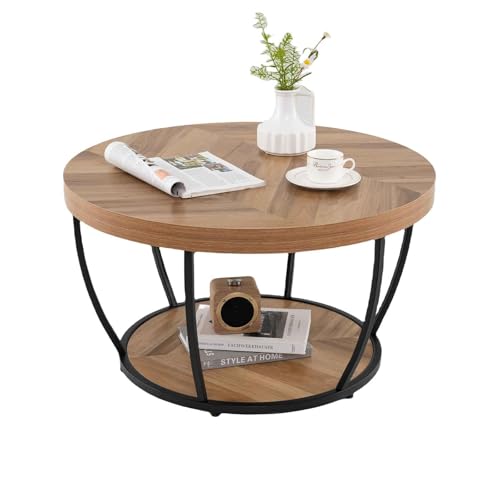
An unpainted raw metal frame under a natural wood top, 80 cm long. Raw metal ages by developing a clean patina rather than a peeling paint job: a deliberate choice rather than a fault to fix.
We watch the tables on this page for you. One email when one of them drops, nothing else.
As an Amazon Associate, we earn from qualifying purchases. The product links on this page may earn us a commission if you buy something — at no extra cost to you. Prices shown may have changed since we last checked.
Written by the Tavolia Bassio team
We don't test the furniture: we record each piece's measurements one by one and say where our figures come from. When a dimension is missing from a listing, we say so instead of guessing. Our method.