HomeMaterialWood or Steel: Which Coffee Table Should You Choose?
Material
Wood or Steel: Which Coffee Table Should You Choose?
Wood warms a room; steel gives it structure — two opposite ways of thinking about a coffee table, and yet the two are often combined on the same piece. When one takes the upper hand over the other, the look changes noticeably, between a warmer wood-led living room and a more assertive metal-led one. Four models to compare where each material wins out, and where mixing the two actually makes sense. For a cosier feel, see which coffee table for a cosy living room, or for a tougher public space, which coffee table for a waiting room. The full steel coffee table range covers every finish beyond these four, and a solid wood coffee table or the wider wooden table range selection takes the warmer side further, alongside a travertine coffee table for a stone alternative.
A Wood Dark Industrial, Rustic wood top on a slim X-shaped steel frame, 100 cm long, at around £40. The contrast between warm wood and slim metal gives a Scandinavian style that's quite sought-after for the price. The slim frame, though, offers less stability than a thicker steel structure if you lean on it to get up.
FineBuy Table Basse 110x60x40 cm Bois Massif Acacia Rectangulaire
110 x 40 x 60 cm · Acacia
A model in thick solid Acacia wood, 110 cm by 60 cm, with no visible steel at all, at around £120. The weight of solid wood guarantees a stability that even a good slim steel frame doesn't always match. Its upkeep, though, calls for a light annual waxing to keep the original look, something a lacquered steel top never asks for.
IDMarket, Table Basse Fixe Madeleine Double Plateau Bois et Noir
100 x 55 x 40 · Wood
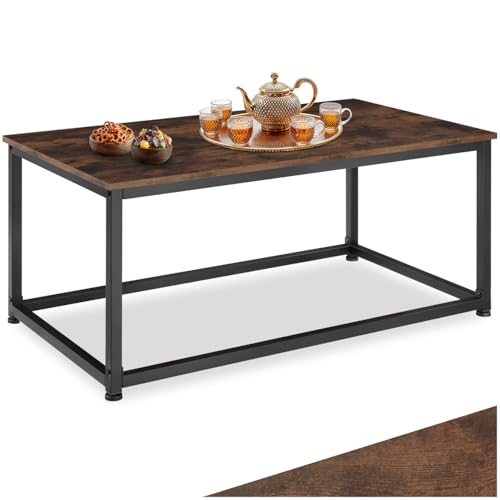
An all matt-black steel structure with a Wood wood-veneer top set into it, 100 cm across, at around £50. Steel takes the lead role here, with wood only showing on top. That split keeps wood upkeep down to a small surface, but gives the whole piece a more industrial than cosy look.
A nesting model mixing solid Brown Rustic + Black wood with gold steel legs, two sizes, 100 cm for the larger one, at around £70. Nesting tables multiply the uses without multiplying the everyday clutter. The gold frame, striking to look at, shows fingerprints faster than matt black steel, which means wiping it down more often.
A solid or veneered wood top brings a visual warmth that steel alone never recreates: the natural grain, the shade variations from one plank to the next, give every piece a character that's slightly different from the next one. Unlike natural wood grain, our pick of stone-look tables stays visually consistent from one piece to the next.
This material lives with time: it develops a patina, takes on a deeper shade under light, and wears its small marks of use like a trace of history rather than a flaw, unlike a lacquered top that shows off every scratch as a mistake.
Its upkeep stays moderate but real: regular dusting and the occasional treatment are enough, nowhere near the workload of a fabric piece, but more than a simple wipe over steel.
Key point Its upkeep stays moderate but real: regular dusting and the occasional treatment are enough, nowhere near the workload of a fabric piece, but more than a simple wipe over steel.
Steel, the backbone of the piece
When steel takes on the structural role, it brings a rigidity that wood alone, especially thin veneer, doesn't always guarantee over time. That's particularly true on nesting models, where each table has to stay stable despite a narrower base.
Visually, a slim X- or cross-shaped steel frame lightens the piece's silhouette, letting you see the floor underneath, something a thicker wooden frame hides more.
Its limit stays down to temperature and sometimes sound: a knock on an all-metal structure rings out more than one on wood, a detail that matters in a living room where you're after a bit of quiet.
Key point Its limit stays down to temperature and sometimes sound: a knock on an all-metal structure rings out more than one on wood, a detail that matters in a living room where you're after a bit of quiet.
Finding the balance between the two
The most common compromise is a wood top on a steel frame, which combines the visual warmth of wood with the structural stability of metal. It's the choice that suits most living rooms, neither too cold nor too heavy on the eye.
For an interior that already leans towards a bolder style, with metal present elsewhere in the room, a more all-steel model like the one shown here reinforces that consistency without having to change everything else around it.
Key point For an interior that already leans towards a bolder style.
Worth knowing
Frequently asked questions
Does a veneered wood top last as long as a solid one?
Not as long if it takes a deep knock, since veneer can't be sanded down the way solid wood can. For everyday use with no violent impact, the difference stays minor day to day.
Does the steel on a coffee table make noise when objects are set down on it?
A slight clink can happen on a slim structure, especially with no wood top to cushion it, unlike a model where wood covers the whole contact surface.
Does a wood-and-steel mix suit a more classic style, or only a contemporary one?
Both, depending on the wood treatment and the metal finish: dark wood with matt black steel leans contemporary, while light wood with slim gold steel can fit into a more classic interior, even a reworked period-style one.
Does a wood-and-steel table scratch more on the wood part or the metal part?
Wood generally marks more visibly on impact than a painted steel structure, but it's repaired more easily with local sanding, unlike metal, where a deep scratch stays there for good unless you repaint the whole part.
Does a gold steel frame tarnish over time on a table combining wood and metal?
Good-quality gold metal keeps its shine for several years with minimal care. An abrasive or acidic cleaner can attack it prematurely; a simple dry or slightly damp cloth is more than enough to preserve the finish over time.
Is a wood-and-steel nesting table as stable as a fixed model once the two are pulled apart?
Yes, each piece stands on its own legs and is fully stable once separated, despite what you might assume. Only the smaller top table offers a slightly smaller surface, worth keeping in mind for bulkier objects.
Does the wood-and-steel contrast suit a living room with already bold, bright colours?
Yes, this mix works as a balanced neutral: wood brings warmth without visually overloading the room, while steel stays understated and never competes with bright colours already on the walls, cushions or rug.
Does a wood-and-steel table suit a living room with a cat that likes to scratch wooden furniture?
With some caution on the wood part, which is more sensitive to scratching than a steel structure. Keeping the wood side out of easy reach, or choosing a model where steel dominates more of the visible surface, limits that risk for households with a very playful cat.
Can the solid wood on a wood-and-steel table be restained in a different colour later?
Yes, a full sanding followed by a suitable stain lets you change the colour of solid wood, something a veneered top doesn't offer in the same way, since its thin layer of real wood strongly limits this kind of transformation later on.
Does a wood-and-steel mix suit a table that's also used to hold a meal tray?
Yes, no problem for occasional use — the structure copes well with a standard meal tray. A non-slip base simply stops the tray sliding on a varnished wood surface or a slightly angled metal structure.
Does the solid wood on a wood-and-steel table behave differently from one season to the next, summer and winter?
A slight seasonal movement is possible, more noticeable in winter with drying central heating. This natural, subtle effect never compromises the piece's overall sturdiness day to day.
Does a wood-and-steel table suit a covered outdoor living space, like a heated conservatory?
With caution: neither the wood nor the standard steel on these models is designed for prolonged outdoor humidity, even in a conservatory. Strictly indoor use is recommended.
Does a matt black steel frame work as well with light wood as with dark wood?
Yes, matt black stays neutral and goes with any wood shade, unlike gold, which looks better with dark wood than with a very pale species like pine.
Are these wood-and-steel tables easy to move alone when rearranging the living room?
Yes, for most of them — their weight stays reasonable despite the thick solid wood.
Price alert
Tell me when the price drops
We watch the tables on this page for you. One email when one of them drops, nothing else.
As an Amazon Associate, we earn from qualifying purchases. The product links on this page may earn us a commission if you buy something — at no extra cost to you. Prices shown may have changed since we last checked.
Written by the Tavolia Bassio team
We don't test the furniture: we record each piece's measurements one by one and say where our figures come from. When a dimension is missing from a listing, we say so instead of guessing. Our method.


 VASAGLE Table Basse, Table de Salon Re