A lift-top turns a simple square coffee table into a dining table or a spare desk, without bringing another piece of furniture into the room. The six models gathered here mainly differ in the height actually reached once raised, and in the mechanism, gas struts or a rack system, that does the job. Some also hide full storage under the top, doubling the table's usefulness in a living room already short on floor space. Always check the exact raised height stated: a table that only reaches halfway to a real dining table stays uncomfortable for eating seated on an ordinary chair, not just for the odd occasion standing up.
Which one to choose, based on your living room
If budget is the deciding factor
IDMarket, Table Basse Plateau relevable carrée ELEA avec Coffre Bois B
IDMarket, Table Basse Plateau relevable carrée Detroit Design Industri
70 cm x 70 cm x 40,5 cm · Grey Dark
A lift-top with a bold industrial style, wood and metal finishes for a properly loft-like look. Flat, it measures 70 cm by 70 cm, and stands 40.5 cm high, in a dark Grey Dark. The lift mechanism needs a firm push to work: it's not as quiet as a system fitted with more modern hydraulic struts. The industrial style suits furniture already leaning that way visually. The low starting price quoted by the seller is a secondary point next to the real question of how you'll actually use the lift-top.
IDMarket, Table Basse Plateau relevable carrée ELEA avec Coffre Bois B
70 cm x 70 cm x 42 cm · White
Three storage areas on top of the lift-top itself, for genuinely varied everyday use. Flat, it measures 70 cm by 70 cm, and stands 42 cm high, in a light White. With three separate spaces to fill, the piece asks for a bit more regular upkeep than a simple table with no storage at all. The beech-effect finish softens the dominant white, for a look less clinical than plain white alone. The trendy, tidy style, as described by the maker, suits a recently refreshed living room well.
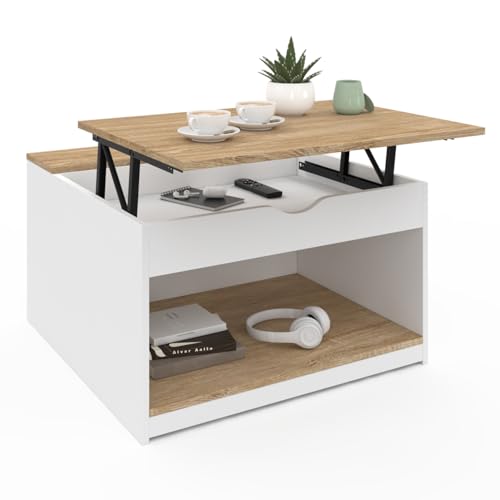
A smooth-running lift-top with storage hidden under the surface, designed to keep everyday items entirely out of sight. Flat, it measures 80 cm by 80 cm, and stands 43 cm high, in a contrasting White and Walnut. But the hidden storage means raising the whole top to reach it, unlike a side drawer you open in one quick move. The smooth mechanism still counts as a real plus for anyone who uses the table often. The tidy, discreet organisation promised by the maker makes good use of space with nothing left on view.
A rustic-chic style with a natural wood-effect finish and a top that lifts for the odd meal or improvised work session. Flat, it measures 105 cm by 74 cm in an elegant White and stays at coffee-table height; raised, the top reaches dining height. The rustic style, though, needs an interior already leaning that way in tone to fit in without clashing. The natural wood effect feels pleasant to the touch, though the shade can vary slightly from one piece to another. The rustic-chic style, highlighted by the seller, pairs well with a pale fabric sofa.
GOPLUS 3 en 1 Table Basse Relevable avec roulettes
60-120x60x50CM · White
Three uses in one, with castors and adjustable height, for eating, working as a desk or serving as an ordinary coffee table. Flat, it measures 120 cm by 60 cm, and stands 50 cm high, in an understated White. The hydraulic struts are reassuring on safety, but this mechanism makes the piece noticeably heavier than an equivalent fixed model. The advertised versatility still takes some getting used to before you've mastered the adjustments. The quiet, secure system, as described by the maker, gives peace of mind for use around young children.
BTM Table Basse Blanche avec Eclairage LED Réglable
70 x 70 x 36 cm · White-LED-centre
Built-in LED lighting at the centre of the top, on top of the lift function that's now fairly standard on this kind of table. Flat, it measures 70 cm by 70 cm, and stands 36 cm high, in a bright White-LED-centre. But the lighting is controlled by Bluetooth, which means installing an app before you can actually use it in the evening. The square top stays compact, handy for a living room a little short on floor space. The LED lighting at the centre, as described by the maker, remains a decorative extra rather than a real functional need.
A standard dining table sits around 75 cm high: that's the benchmark to keep in mind when judging whether a lift-top genuinely suits eating seated on a chair, rather than just the odd standing use in front of the sofa. Since that benchmark height decides everything, our full lift-top range gathers the models that genuinely reach dining level once raised.
Some models only raise the top halfway, handy for working comfortably from the sofa but not enough to replace a real dining table long term, day in, day out.
Also think about legroom once seated on a chair facing the raised top: a square table designed to stay low sometimes lacks the clearance a proper dining table, built with this use in mind from the start, always provides.
Check stability once raised too: a top that wobbles in the high position is more of a nuisance than a fixed table, especially if you're setting down a hot dish or an open laptop.
Key point Check stability once raised too: a top that wobbles in the high position is more of a nuisance than a fixed table, especially if you're setting down a hot dish or an open laptop.
Struts, rack or crank
The mechanism chosen mainly changes day-to-day comfort. A hydraulic-strut system rises with a gentle push and lowers itself back down smoothly, while a rack mechanism needs a firm push all the way to the height you want. Lifting is only one way to gain surface, so our guide on castors or extendable coffee tables lays out the two other common mechanisms side by side. Prefer a gentler way to gain surface with no moving parts at all? Our glass nesting coffee tables achieve it by sliding, not lifting.
Storage hidden under the top remains a real plus in a tight living room, as long as you accept having to raise the whole thing to reach it: never as quick as a drawer opened with a simple sideways pull.
Before buying, picture the real use realistically: a lift-top usually serves an occasional purpose, not every meal, unless your living room also doubles as a genuine dining room day to day.
Key point Before buying, picture the real use realistically: a lift-top usually serves an occasional purpose, not every meal, unless your living room also doubles as a genuine dining room day to day.
Weight: the trade-off of the mechanism
A lift-top carries struts, a rack or castors on top of the standard frame: naturally, the whole piece weighs more than a fixed coffee table of comparable size with no mechanism to house. When weight matters more than the mechanism, a simpler build makes sense: browse our wooden chest storage coffee tables for that lighter approach. To keep the piece easier to shift around the room, a lighter panel build helps, which is what our LED coffee tables in MDF offer.
That extra weight has a real upside once the table is in place: it stays more stable on the floor and shifts less easily than a lighter model, worth having if the top often doubles as a work surface.
In exchange, moving house or simply rearranging the living room takes more effort to shift the piece, unlike an ordinary coffee table you can lift without any trouble.
Key point In exchange, moving house or simply rearranging the living room takes more effort to shift the piece, unlike an ordinary coffee table you can lift without any trouble.
Who this mechanism really makes sense for
A lift-top suits anyone who often hosts an impromptu meal, or regularly works from the sofa without wanting to fit a proper desk into the living room. Not everyone eats or works from the sofa, and for those who simply need tidy storage our designer coffee tables with drawers fit better.
For purely decorative use, with the top never actually raised, the mechanism becomes extra weight and upkeep with nothing to show for it: a simpler fixed table, with no struts or rack to keep an eye on, makes more sense then.
Before deciding, count how many times a week a real dining table would actually be missed in your current living room: that figure, more than style, is usually what justifies this extra mechanism or not.
Key point Before deciding, count how many times a week a real dining table would actually be missed in your current living room: that figure, more than style, is usually what justifies this extra mechanism or not.
Price alert
Tell me when the price drops
We watch the tables on this page for you. One email when one of them drops, nothing else.
As an Amazon Associate, we earn from qualifying purchases. The product links on this page may earn us a commission if you buy something — at no extra cost to you. Prices shown may have changed since we last checked.
Written by the Tavolia Bassio team
We don't test the furniture: we record each piece's measurements one by one and say where our figures come from. When a dimension is missing from a listing, we say so instead of guessing. Our method.




 BTM Table Basse Blanche avec Eclairage
 HOMCOM Table Basse Plateau Relevable 1
 YU YUSING Table Basse Relevable Carrée