A Scandinavian living room is known for what it doesn't show: no trailing cables, no pile of magazines dumped just anywhere. The piece of furniture that carries this style has to do double duty — staying visually light while swallowing everyday clutter. That's the whole challenge of a Scandinavian coffee table with storage: it promises the clean lines of pale wood alongside the function of a storage unit, two demands that don't always sit comfortably together. Sliding doors, open niches, discreet drawers: each system answers the same question differently — what do you do with things you'd rather not see lying around? Six models to help you decide, with their real measurements, before bringing one of them into your living room.
[en.casa] Table Basse Design Scandinave avec 2 Portes Coulissantes et
100 x 50 x 40 cm · Blue
100 cm across the front, 50 cm deep, 40 cm high: this [en.casa] model plays the closed-storage card, with two sliding doors that hide the living room's clutter behind a Blue front. The inner compartment swallows magazines, throws and board games with nothing left sticking out. Sliding rather than hinged, the doors need no clearance in front of the table, which helps against a tightly placed sofa. The trade-off of a closed unit: it gets dirty inside too, and needs opening now and then so things don't just pile up unsorted.
50 cm deep by 91 cm long, 37 cm high: this Demeyere table goes for open rather than closed, with three slatted niches in White instead of doors. Nothing to slide, nothing to close: you set the object down and spot it again at a glance. The pale wood and matt white contrast stays true to the most classic Scandinavian codes. The limit of open storage, precisely: it shows what you keep in it, where a closed unit hides the clutter rather than putting it on display.
Menzzo Table Basse scandinave Bergen Blanc & Bois Clair
95 · Wood/White
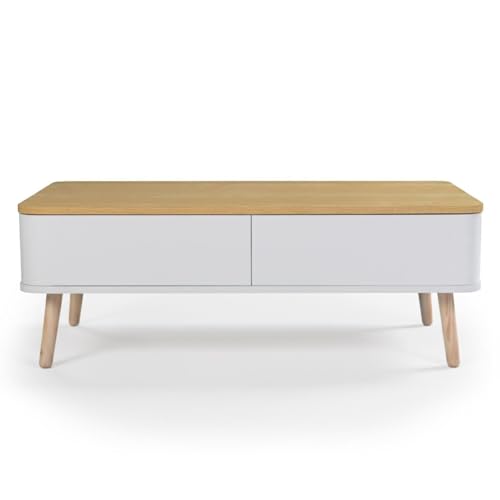
Made by Menzzo, this Wood/White table goes for drawers rather than the open niches or the door-fronted unit of the two previous models: several discreet drawers swallow remote controls and small items without ever putting them on show. A drawer closes with one motion, unlike a sliding door that has to be pushed all the way along its rail. Expect to pay around £90 for this model, positioned mid-range. The downside of drawers: they take less loose weight than an open shelf, so it's best not to stack thick books inside.
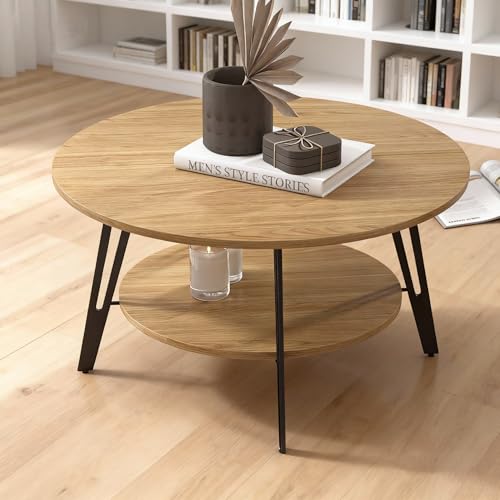
Round, 43 cm high for 78 cm across: Manora breaks from the rectangular shape of the first three models. Its two-level low shelf works as open storage, designed to show off rather than hide everyday items. A round shape clears the corners in a narrow walkway, something a rectangular top doesn't always allow. The trade-off of a round table: it offers less usable surface for setting things down than a rectangle taking up the same floor space.
[en.casa] Table Basse avec Portes Coulissantes et Compartiments de Ran
120 x 55 x 40 cm · Natural
Reckon on 40 cm high, 120 cm long, 55 cm deep: [en.casa] takes up the sliding-door principle of the first model, this time in a Natural finish, with a central shelf that doubles the closed storage capacity. Two levels rather than one, useful for keeping everyday items separate from those used less often. Its length only suits a living room with the space in front of it: against a two-seater sofa, it juts out well past both sides with nothing to hold it back.
Table Basse Tibor Style scandinave Design Vintage Nordique Table de Sa
90 x 36 x 60 cm · White
90 cm long, 60 cm deep, 36 cm high: IDIMEX combines two drawers and two open niches, the only one of the six to mix both storage systems. The style stays vintage Nordic, in solid pine finished with a White stain that lets the wood grain show through. Combining two systems also multiplies the upkeep: the niches need dusting by hand, and the drawers sometimes stick when overloaded, unlike a plain bare top that asks nothing of you.
A closed unit with sliding doors protects its contents from dust and from view, but it means opening it up just to grab the remote — one more step than an open shelf, where the item stays visible and reachable in a single move. An open niche, on the other hand, also puts what you set down on show: it takes a bit of discipline to stop it becoming a clutter zone of its own. If opening a door just to grab the remote annoys you, a rising-top coffee table keeps everything under a surface you raise in one movement.
Drawers sit somewhere between the two: they hide their contents like a closed unit, while opening faster than a sliding door that has to be pushed all the way along its rail. Their limit lies in the weight they take: a drawer stacked with books eventually sticks, where an open shelf takes the same weight without complaint.
Before choosing, ask yourself a simple question: what do you actually keep in your living room? Things you use every day (remotes, chargers) suit open storage or an easy-access drawer. Things you'd simply rather make disappear (cables, bills, toys) deserve a closed unit, even at the cost of quick access in exchange for a tidier living room.
One last thing to check before buying: the top should sit below the seat height of your sofa, around 45 cm at most, so reaching up to put a glass down never becomes awkward.
Key point One last thing to check before buying: the top should sit below the seat height of your sofa, around 45 cm at most, so reaching up to put a glass down never becomes awkward.
What the material changes
The Scandinavian style is known for particular materials: pale wood (oak, beech, pine), matt finishes, sometimes a white lacquer as a complement. Across the six models on this page, you'll find stained solid pine, pale oak veneer and matt white lacquered panels — three different ways of reaching the same Nordic feel, with budgets and upkeep that don't match each other at all. Pale wood and matt finishes take a beating in a family room, so read the guide to coffee tables for storing toys first. White lacquer earns its place on wheels too, as the white coffee table on castors shows for a room you rearrange often. If the room doubles as a dining space now and then, the white extendable coffee table keeps the pale look while gaining surface. Matt Nordic finishes can carry light as well, and the white LED coffee table shows what that adds to a dim living room. Rather than one storage unit, some rooms do better with two surfaces, which is the case the white nesting coffee table makes.
Solid pine scratches more easily than oak veneer, but it also repairs better: a light local sanding is often enough to lift a mark, something a veneer never forgives in the same way. Veneer, in exchange, copes better with the humidity swings of a living room heated in winter and less so in summer.
White lacquer, common in this style, shows every fingerprint on doors and drawers — a known downside of any matt, pale surface. A dry microfibre cloth is enough day to day; save the sponge and soap for special occasions, when a more stubborn mark has settled in.
None of these three choices is a bad one in itself: pine suits anyone after a tighter budget who accepts a patina over time, oak veneer suits anyone after a more polished look without the price of solid wood throughout the whole structure.
Key point None of these three choices is a bad one in itself: pine suits anyone after a tighter budget who accepts a patina over time.
Price alert
Tell me when the price drops
We watch the tables on this page for you. One email when one of them drops, nothing else.
As an Amazon Associate, we earn from qualifying purchases. The product links on this page may earn us a commission if you buy something — at no extra cost to you. Prices shown may have changed since we last checked.
Written by the Tavolia Bassio team
We don't test the furniture: we record each piece's measurements one by one and say where our figures come from. When a dimension is missing from a listing, we say so instead of guessing. Our method.

![[en.casa] Table Basse avec Portes Coulissantes et Compartiments de Rangement Table d'Appoint Massif Intemporel](https://m.media-amazon.com/images/I/51ACvH3rOXL._SL160_.jpg)
![[en.casa] Table Basse Design Scandinave avec 2 Portes Coulissantes et Compartiment de Rangement Table d'Appoin](https://m.media-amazon.com/images/I/51Oi9FfzdxL._SL500_.jpg)

![[en.casa] Table Basse avec Portes Coulissantes et Compartiments de Rangement Table d'Appoint Massif Intemporel](https://m.media-amazon.com/images/I/51ACvH3rOXL._SL500_.jpg)

![[en.casa] Table Basse Design Scandinave avec 2 Portes Coulissantes et Compartiment de Rangement Table d'Appoin](https://m.media-amazon.com/images/I/51Oi9FfzdxL._SL160_.jpg) [en.casa] Table Basse Design Scandinav
[en.casa] Table Basse Design Scandinav Menzzo Table Basse scandinave Bergen B
 Table Basse Tibor Style scandinave Des