A coffee table on castors solves a problem plenty of people discover too late: having to lift a heavy piece every time you vacuum or have guests round. Rolling on its castors, it pushes with one hand towards a corner of the room, then comes back to its original spot just as easily. The trade-off is felt on soft flooring: thick carpet slows the roll far more than tiles or a wooden floor. Some models add a brake on at least two castors, a real plus to stop it drifting on its own on a slightly sloped floor. Six models are compared here on castor quality, the tabletop and braking. The wider range of coffee tables on castors covers shapes beyond this rectangular set if none of the six fits.
Which one to choose, based on your living room
If budget is the deciding factor
Table Basse Rectangulaire à roulettes Vérouillables pour Salon Meuble
Table Basse Rectangulaire à roulettes Vérouillables pour Salon Meuble
60 cm x 70 cm x 35 cm · White
Four swivelling castors with no brake carry this White rectangular top of 70 cm, set at 35 cm for low use in front of a standard sofa. The lack of a brake costs you on a smooth floor with a slight slope: the table can then roll off on its own, a point to watch in a room that isn't perfectly level. Reckon on around £40 for this entry-level model.
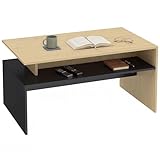
HOMCOM Table Basse Rectangulaire Bicolore 95x55x50 cm Bois Naturel et
95l x 55P x 50H cm · Wood Natural
Wider castors than average, built for tiled floors, come with this Wood Natural model, its top measuring 95 cm by 55 cm and 50 cm high. Once in place, the whole piece stays stable with no effort. These wide castors do sometimes leave a slight groove in thick carpet left in place for several weeks, at a price of around £50.
Two braked castors out of four give this Natural+white top of 105 cm a balance between mobility and stability, at 46 cm off the floor for most living rooms. The trade-off of this balance: the brake has to be applied by hand each time it's moved, a step that sometimes gets forgotten over time. Price seen: around £70.
FineBuy Table Basse 110x60x40 cm Bois Massif Acacia Rectangulaire
110 x 40 x 60 cm · Acacia
Low storage that stays accessible even with the castors deployed sets this Acacia top apart, the largest in the group at 110 cm long and 60 cm deep for 40 cm high, built for a large sofa. Its generous size does make it less nimble to move through a narrow hallway than a more compact model. A price of around £120 reflects this generous format.
IDMarket, Table Basse Extensible relevable en Table à Manger rectangul
114 cm x 100 cm x 75 cm · Brown and Black
Nighttime use without waking the rest of the household is the promise behind the silent castors on this Brown and Black model, its 114 cm top lifting up to switch from coffee table to dining table. So long as it rolls on a hard floor, the movement stays smooth; on thick carpet, it takes more of a push than the product listing suggests. Sold at around £100.
HOMCOM Table Basse en Verre Rectangulaire 80 x 45 x 35 cm Transparent
80 x 45 x 35 cm · Transparent
The safest option in this set for a household with young children, this Transparent top of 80 cm by 45 cm locks its castors on all four corners, for a height of 35 cm in line with the rest of the segment. Locking all four castors does take longer, though, than on a model with just two brakes. Price: around £90.
The first advantage shows up when cleaning: a table on castors pushes aside with one movement to vacuum or mop underneath, with no need to lift it by hand. That's a detail that matters day after day.
It also makes rearranging the living room easier now and then, to clear space for a party or a home workout. The piece then rolls back into place with no real effort.
Anyone weighing mobility against hidden storage can read the comparison of a storage coffee table versus a chest coffee table for the fixed alternative. The trade-off to accept: a table on castors sometimes moves on its own without you meaning it to, especially with no brake — worth watching if the living-room floor isn't perfectly flat.
Key point The trade-off to accept: a table on castors sometimes moves on its own without you meaning it to, especially with no brake — worth watching if the living-room floor isn't perfectly flat.
The type of floor changes everything
On a wooden or tiled floor, castors roll easily and effortlessly, even loaded with things on the top. That's the most favourable surface for this kind of piece. Rolling is one way to gain flexibility, growing is another, as our pick of the best extendable coffee tables makes clear.
On thick carpet, rolling takes more force, and some slim castors struggle to move in a straight line. Wide castors, built for this kind of floor, mostly correct this issue.
On a thin rug laid over a wooden floor, the piece tends to drag the rug along with it at the first nudge, a point worth testing before settling on its final spot.
Key point On a thin rug laid over a wooden floor, the piece tends to drag the rug along with it at the first nudge, a point worth testing before settling on its final spot.
Brake or no brake: how to decide
A brake on at least two castors stops accidental movement, useful in a living room that gets a lot of foot traffic or sits on a slight slope. Applying the brake soon becomes second nature after a few weeks of use.
Without a brake, the table stays easier to push with one hand, a real plus for anyone moving it several times a day. The risk of it drifting on its own stays real, though, on a smooth floor.
A modern lift-top coffee table removes the rolling question entirely by staying fixed in place while still adapting to different uses. For a household with young children who sometimes climb on low furniture, a fully lockable model stays the more sensible choice, even at the cost of a little mobility.
Key point For a household with young children who sometimes climb on low furniture, a fully lockable model stays the more sensible choice, even at the cost of a little mobility.
The tabletop: a surface that has to keep up with movement
A top firmly fixed to the frame copes better with the jolts of being moved than one simply resting on it. Check this on delivery — a top that moves independently of the legs wears out faster. Where a fixed top is the priority, that same sturdiness question comes up in our pick of the best lift-top coffee tables.
The weight of items left on it also affects stability while moving: a top loaded with books rolls less smoothly than a near-empty one, with a risk of things sliding off.
A discreet rim around the edges of the top, where fitted, stops a glass sliding off when the table is pushed, a simple but useful detail day to day.
Key point A discreet rim around the edges of the top, where fitted, stops a glass sliding off when the table is pushed, a simple but useful detail day to day.
Looking after the castors over time
Regularly dusting the castor axles stops the creaking that appears after several months on a dusty floor. A dry cloth or a small brush is usually enough.
Avoid rolling the table over a wet floor: damp gets into the axle and speeds up wear on the pivot mechanism far faster than dry use.
An oak lift-top coffee table needs none of this castor upkeep, trading mobility for a sturdier, fixed footprint. If a castor creaks despite cleaning, a drop of light oil is often enough to restore smooth movement, with no need to replace the whole part.
Key point If a castor creaks despite cleaning, a drop of light oil is often enough to restore smooth movement, with no need to replace the whole part.
Price alert
Tell me when the price drops
We watch the tables on this page for you. One email when one of them drops, nothing else.
As an Amazon Associate, we earn from qualifying purchases. The product links on this page may earn us a commission if you buy something — at no extra cost to you. Prices shown may have changed since we last checked.
Written by the Tavolia Bassio team
We don't test the furniture: we record each piece's measurements one by one and say where our figures come from. When a dimension is missing from a listing, we say so instead of guessing. Our method.


 HOMCOM Table Basse Rectangulaire Bicol
 SOARS Table Basse Bois Rectangulaire 2
 FineBuy Table Basse 110x60x40 cm Bois