HomeFeatureNesting or Castors: Which Coffee Table Should You Choose?
Feature
Nesting or Castors: Which Coffee Table Should You Choose?
Nesting or castors: two opposite answers to the same mobility problem. Nesting puts you in charge of the floor by removing a table when you need the space. Castors leave you with a single table you push when the moment calls for it. But castors slide when you least want them to, and nesting tables force you into constant tidying up. Our roundup of the best coffee table on castors, our comparison of storage or lift-top coffee table, a marble-effect nesting coffee tables set and our guide to which coffee table for an office corner all cover related angles this page doesn't. Here's how to choose based on how you actually live, not on wishful thinking.
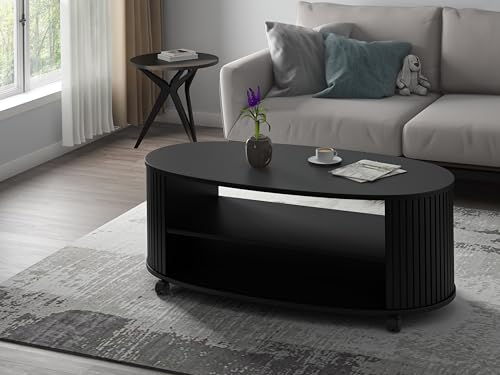
SIMMOB designs an oval black table from SIMMOB offering two systems: castors OR fixed feet, your choice at assembly. This build flexibility suits the undecided. The 120 cm oval table fits into awkward corners better than a square one would. The castors lock, a genuine plus for child safety. However, poorly adjusted fixed feet create play in the structure.
Ginhow offers a round nesting set of two tables measuring 80 x 45 cm, in a white marble effect with a black frame. Pulling out the extra small table opens up leg room when guests come round, in moments. Mixing white marble and black in the same living room needs a confident eye to avoid a patchwork look. The flaw: once nested together, the tables rarely get separated, since it's simply too much of a chore.
IDMarket, Table Basse Extensible relevable en Table à Manger rectangul
114 cm x 100 cm x 75 cm · Brown and Black
IDMarket transforms with an extendable lift-top table measuring 114 x 100 cm: it rises in height and stretches out to become a dining table. Extreme multi-functionality. The black base stays fixed on its single castor foot, so it never tips over. However, this jack-of-all-trades table ends up middling at everything: neither a true coffee table nor a true dining table.
WOLTU closes with a white table measuring 100 x 53 x 50.5 cm with a lift-top and 5 universal castors. This pure mobility table with 5 castors stays stable even when moved often. The top lifts up easily and the glossy white wood suits almost any décor. The problem: too mobile, it slides at the mere weight of a cat jumping on it, meaning the brakes always need to be engaged.
A nesting set frees up floor space by removing a table: it's done in moments. For an even more compact solution than either of those, the fold-flat models shrink down instead of just rolling away. You create a wide walkway to move around freely. Castors also offer mobility, but of a single table: you never move it more than 30 cm, since that never feels like enough anyway. The walkway stays narrow.
Castors allow micro-adjustments: shifting the table 5 cm to seat a guest, 10 cm for a second coffee table if you're hosting a bigger group. Nesting forces a binary choice: tables together or apart. No middle ground.
Work out your real mobility needs: do you rearrange the table 3 times a year or 3 times a week? Fewer than 10 times a year, go for nesting. More than that, go for castors, even if it's less elegant.
Key point More than that, go for castors, even if it's less elegant.
Braking and child safety
Castors without a brake slide too easily: they catch out anyone living with them. A child tugs, the table slides, glasses fall. Braked castors require remembering to lock them every time you stop, which is easy to forget. A fixed nesting table offers total peace of mind: a nested table doesn't move. The other table simply disappears from sight.
A fixed table with children around lets you relax: no need to keep an eye on it while cooking. Castors demand constant vigilance, or a brake permanently engaged, which becomes a tiring habit to maintain.
A coffee table height of 45 cm is the upper limit: beyond that, it's really more of a side table. Check that yours stays below whatever seat height you had in mind, whether castors or nesting.
Key point Check that yours stays below whatever seat height you had in mind, whether castors or nesting.
Space freed or space wasted
A removed nesting table frees up a real stretch of floor. In a smaller living room, that's space worth having. You picture that gap being used to stretch out or set up a game on the floor. The reality: you rarely leave the tables apart for more than 2 hours, putting them back together out of habit.
Castors free up no space at all unless you wheel the table out of the room entirely, which nobody does. They become the obstacle that gets in the way of vacuuming the floor, moving towards the balcony, or a quick exit in an emergency. Psychologically, you see them as useful. In practice, they take up space.
The real question: in your actual living room, when did you last see empty floor space go to waste? Never, castors are enough. Often, nesting is worth it, but be ready for the discipline of stacking them back together.
Key point Often, nesting is worth it, but be ready for the discipline of stacking them back together.
Keeping the mechanisms in shape
A worn nesting table starts scraping at the legs after a while, and the friction only gets worse with continued use, eventually becoming unusable without sanding the legs, which ruins the finish. After that, you leave the tables apart for good.
Castors get clogged: dust, hair and crumbs wrap around the axle. In time, they roll badly. You need to clean the castors regularly with a toothpick, something people rarely remember to do often enough. The brakes, where fitted, also seize up without regular upkeep.
Neither offers true maintenance-free living. Nesting lets you off the hook sooner than castors, which brings a small gain in peace of mind.
Key point Nesting lets you off the hook sooner than castors, which brings a small gain in peace of mind.
Your lifestyle decides the choice
Nesting suits you if: you live in a small space, you love optimising every square centimetre, you're single or a couple with no young children, you clean your living room regularly. Nesting means committed minimalism.
Castors suit you if: you have a fairly large room, children who play on the floor, you rearrange furniture several times a season, you forget to tidy up quickly. Castors mean practicality.
Test your real need: keep the tables stacked for a week. No sense of loss, and you like the extra space? Nesting wins. Frustrated after 3 days and wanting to separate them? Go with castors, and know exactly why you chose them, that honesty is what counts.
Key point Go with castors, and know exactly why you chose them, that honesty is what counts.
Price alert
Tell me when the price drops
We watch the tables on this page for you. One email when one of them drops, nothing else.
As an Amazon Associate, we earn from qualifying purchases. The product links on this page may earn us a commission if you buy something — at no extra cost to you. Prices shown may have changed since we last checked.
Written by the Tavolia Bassio team
We don't test the furniture: we record each piece's measurements one by one and say where our figures come from. When a dimension is missing from a listing, we say so instead of guessing. Our method.


 SIMMOB Table Basse Ovale