Grey has become the most versatile colour for a coffee table: it works with a beige sofa just as well as a midnight-blue one, something raw wood or pure white doesn't always manage as easily in every room. You still need to pick the right shade, though: matt concrete grey, the smoked grey of a glass top, or the light grey of a metal frame don't have the same effect once set down in an already furnished room. Some of these six grey tables add a mechanism, lighting or storage on top of the surface itself; others go for simplicity and a lower price. Whatever the shade, there's a table here to match your living room properly rather than clash with the rest of the furniture. If you'd rather skip straight to a single recommendation, our pick for the best grey coffee table covers the model worth trusting most.
What sets each model apart
The largest tabletop
KIMENICH Table Basse Relevable et Pliante
50*100*46.5 · Grey
At 100 cm long once extended, this Grey table lifts and splits apart to become two separate desks when needed, a rare three-in-one mechanism on this page. At 46.5 cm, it stays low in ordinary coffee-table mode, with nothing sticking out. Packing that many mechanisms into one coffee table means, in return, more fiddling to switch between uses: this isn't a model you set up once and then forget about.
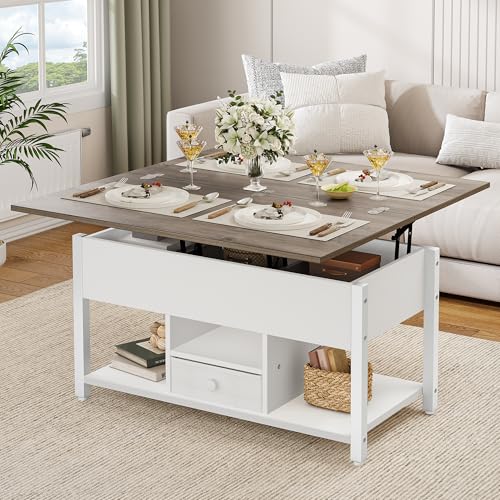
At 90 cm long, this four-in-one White and Grey table adds drawers to its lift-top surface, giving you storage without needing a separate piece of furniture in the living room. At 47.5 cm in the low position, the drawers stay easy to reach even with the table closed and the top down. The white frame, unlike the grey top, shows fingerprints faster, worth knowing if children often run their hands over it during the day.
HOMCOM Lot de 2 Tables Basses Gigognes Table Basse Ronde Empilable Gri
78.5x78.5x46.5cm · Grey
78.5 cm across at the front for this Grey cement-effect duo, with the larger table carrying most of the weight once the two are nested together. The black metal frame stands out against the light grey top above it, for a deliberate contrast. The small table tucks underneath with 46.5 cm of clearance, freeing up floor space day to day. Kept apart, both tables balance perfectly well on their own; stacked one under the other, though, only the larger one really carries any weight.
[en.casa] Table Basse de Salon Omlar avec Plateau Rond Ø70x35 cm en Ve
70 x 35 cm · Effect Oak / Grey Smoked
70 cm across, this Effect Oak / Grey Smoked smoked-glass top on an oak-effect wooden leg is the only glass table in this grey selection, with the other five going for a solid top instead. At 35 cm, it stays low and light enough to move from room to room with no effort. Smoked glass hides marks better than ordinary clear glass, but it doesn't erase them completely: a weekly wipe with a cloth is still needed to keep that clean, tidy look.
90 cm long, this Grey sintered-stone top copies the veining of marble on a metal frame with two stacked storage levels. At 45.5 cm, the shelf underneath stays clear for books or magazines within easy reach. Sintered stone stands up well to everyday scratches, but its weight doesn't move around as easily as a wood or glass top: it's best to position it right the first time.
Matt concrete grey absorbs light rather than reflecting it, which keeps it discreet in a room already busy with furniture and different colours. The smoked grey of a glass top, on the other hand, stays translucent: it doesn't visually close off the space, even set in front of a large sofa or in a living room with small windows and little natural light. Should grey end up too muted against your walls, the white coffee table selection gives you the same discretion with far more light bounced back.
A light grey metal frame pairs easily with natural wood around it, with no jarring break in the look; a dark grey stone-effect top calls for an already understated interior, without too many patterns or bright colours elsewhere in the room.
If you're torn between two shades, think about your living room's natural light at different times of day: a dimmer room suits a lighter grey better, while a bright room can easily take a darker grey without ever feeling gloomy. Our white or grey coffee table comparison and our grey or beige coffee table comparison both walk through the trade-offs shade by shade. Still hesitating between two colours altogether?
Key point Still hesitating between two colours altogether?
Grey needs different care depending on the material
A concrete-effect or stone-effect top shows fingerprints less than a glossy grey lacquer, but its textured grain holds on to a bit more fine dust. A dry cloth is usually enough, with soapy water once a week for the more stubborn build-up.
The grey metal of a frame scratches more visibly than wood, and repeated rubbing leaves a clear mark on a dark, matt surface. Always slip a felt pad under the legs if you move the table often, to protect the floor as well as the metal itself.
If you're weighing grey against a warmer tone, the grey or gold coffee table comparison and the grey or walnut coffee table comparison both cover how each holds up over time. Smoked grey glass, finally, needs the same care as ordinary glass: a dry microfibre cloth for everyday fingerprints, with soapy water only for dust that's built up over several days without a wipe-down.
Key point Smoked grey glass, finally, needs the same care as ordinary glass: a dry microfibre cloth for everyday fingerprints, with soapy water only for dust that's built up over several days without a wipe-down.
How much space to leave in front of your sofa
The length benchmark has nothing to do with the colour of the top: a coffee table is always sized against two-thirds of the length of the sofa it sits in front of, whether it's grey, white or raw wood.
For clearance, leave at least forty to fifty centimetres between the edge of the top and the sofa, with the mechanism raised or a drawer open depending on the model: that margin shrinks fast as soon as any extra function is added to a simple fixed top, so it's best to plan a little generously from the start.
A sofa seat usually sits between 45 and 60 cm off the floor: a grey table that goes above that mark even in its low position will make setting down a glass feel a little less natural, whatever shade you choose among these six models.
Finally, if your living room sometimes doubles as a dining spot, bear in mind that a standard dining table sits its top at around 75 cm: of these six grey tables, only the one that splits into two separate desks comes close to that once fully extended.
Keep in mind, too, that grey, unlike white, is more forgiving of a slightly imprecise measurement: a table that runs a few centimetres past the mark you were aiming for shows less on a dark top than it would on a pale one set in the same spot.
One last useful rule of thumb if you're torn between two sizes: a table that's slightly too short beats one that's too long, since a table that's too long gets in the way of foot traffic far more than a missing centimetre or two on the length of the top.
For a see-through look instead, check the grey or clear coffee table comparison; for a warmer neutral, the brown or grey coffee table comparison is worth a read; and for the boldest contrast, the black or grey coffee table comparison lays out both sides. Also think about your living room's evening light: a very dark grey almost disappears once night falls under dim lighting, which can work in your favour or catch you out depending on how you use the room in the evening.
Key point Also think about your living room's evening light: a very dark grey almost disappears once night falls under dim lighting, which can work in your favour or catch you out depending on how you use the room in the evening.
We watch the tables on this page for you. One email when one of them drops, nothing else.
As an Amazon Associate, we earn from qualifying purchases. The product links on this page may earn us a commission if you buy something — at no extra cost to you. Prices shown may have changed since we last checked.
Written by the Tavolia Bassio team
We don't test the furniture: we record each piece's measurements one by one and say where our figures come from. When a dimension is missing from a listing, we say so instead of guessing. Our method.


![[en.casa] Table Basse de Salon Omlar avec Plateau Rond Ø70x35 cm en Verre Table d'Appoint Style Intemporel Bou](https://m.media-amazon.com/images/I/51OSao0BWXL._SL500_.jpg)

![[en.casa] Table Basse de Salon Omlar avec Plateau Rond Ø70x35 cm en Verre Table d'Appoint Style Intemporel Bou](https://m.media-amazon.com/images/I/51OSao0BWXL._SL160_.jpg) [en.casa] Table Basse de Salon Omlar a
[en.casa] Table Basse de Salon Omlar a HOMCOM Lot de 2 Tables Basses Gigognes
 COSTWAY Table Basse en Pierre 2 Niveau
 KIMENICH Table Basse Relevable et Plia
 YITAHOME Table Basse relevable avec ti