Enlarging or hiding, two functions that answer very different moments in a living room's life. An expanding coffee table earns its keep during an impromptu meal or a gathering with several people, when more surface is needed for plates and glasses. Some households prefer visible flexibility to a hidden chest: the stackable timber roundup lets each top move independently. The four models on this page often blend both approaches through a lift-top that plays both roles at once. Compare their mechanism, volume and stability before choosing the one that matches how you actually use your living room. The piece's overall weight is worth a look too, especially if you plan to move it yourself now and then. A heavy model steadies the raised top, a light one makes it easier to clear the whole room before hosting.
Which one to choose, based on your living room
If budget is the deciding factor
IDMarket, Table Basse Plateau relevable Chicago Coffre Effet Vieilli
GOPLUS 3 en 1 Table Basse Relevable avec roulettes
60-120x60x50CM · White
120 cm by 60 cm from GOPLUS, a three-in-one model with castors, a dual-use lift-top and adjustable height to go from living room to occasional desk. At 50 cm in the raised position, it serves as an occasional work table. Its White colour and hydraulic struts said to be quiet make it a versatile model. The downside of this versatility: the combined mechanism, castors plus lift, adds several moving parts to keep an eye on over time, more than a simple fixed chest. Lockable castors prevent any accidental movement once the top is raised for work. A height-adjustable coffee table offers that same flexibility as a dedicated category.
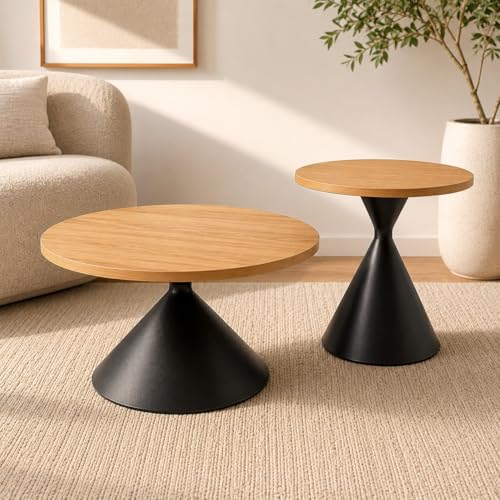
Grande table 70*45*41 CM etpetite table 50*37*56 · Black
A nesting duo from JAZYKA, 70 cm for the larger table and a smaller one to match, in light wood and off-white. At 37 cm for the main table, the set stays low and light to move. Its Black finish contrasts with the light wood tones stated by the manufacturer. Its light weight, handy to move alone, comes with no closed storage nor any top extension, unlike the chest-equipped models on this page. Their compact footprint suits a room where every square metre counts.
IDMarket, Table Basse Plateau relevable Chicago Coffre Effet Vieilli
100 x 55 x 40 · Multicoloured
With an industrial style, IDMarket offers 100 cm by 55 cm here, pairing a lift-top with a chest in wood and metal finishes. At 40 cm, it sits close to standard seat height before the top rises. Its Multicoloured finish and industrial look suit a contemporary or semi-industrial living room. This model's bold style, appealing for some interiors, clashes with a very classic or pastel decor. Visible metal handles reinforce the workshop feel even further.
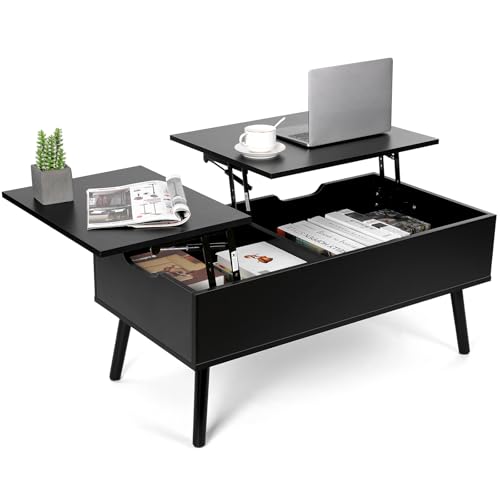
VOWNER raises this model's desk top with an air-pressure lever rather than a traditional spring, on a format of 101 by 51 cm. Once back at 44 cm, it stays discreet in front of the sofa. Its Black colour fits easily into a plain living room. The air-pressure lift, smoother than an older spring system, still doesn't replace a real closed chest for permanently hiding items. Its compact base leaves easy access all round, handy for hoovering.
Extension answers a specific moment, a meal or a get-together, when the usual surface no longer suffices. A chest answers a permanent need: storing what piles up each day without having to think about it.
These two needs rarely coexist in one simple mechanism, which explains why most tables on this page rely on the lift-top as a middle-ground solution, rather than a true extension leaf.
Before choosing, ask which situation comes up more often in your home: hosting several people, or simply wanting a tidy living room day to day.
A simple rule of thumb: count how often you've run short of space for plates over recent months. If you do host regularly, our 60-to-80cm extendable coffee table guide covers that size bracket directly. If the answer is close to zero, a chest will serve you far better day to day than an extension mechanism you'll barely ever use.
Key point If the answer is close to zero, a chest will serve you far better day to day than an extension mechanism you'll barely ever use.
The lift-top as a compromise
Three of the four models here combine a rising top with a storage space, a way to partly meet both needs without piling up furniture.
This raised top serves more as a work surface or an occasional dining spot than a true extension: it lifts rather than lengthens, which changes the use without changing the total available surface.
For a real surface gain during a meal with several people, only a dedicated extension table truly meets the need; the lift-top remains a comfort feature, not an extension.
The hydraulic strut or air-pressure lever that raises this top often needs, more often than not, clearance above it to rise without hitting a wall or a low shelf: check that free space before settling on the table's final spot.
Key point The hydraulic strut or air-pressure lever that raises this top often needs.
Castors, weight and moving it around
The model on castors in this lineup stands out for its mobility, an asset for clearing the centre of the room for an evening, unlike the other three, which stay put once positioned.
A light table in light wood also moves easily by hand, no castors needed, as long as the floor isn't too uneven or covered in a thick rug.
Round nesting coffee tables offer a lighter, more mobile alternative to both. A heavy model with a full chest, by contrast, gains in stability what it loses in mobility: count on some help or built-in castors to move it without straining your back.
Key point A heavy model with a full chest, by contrast, gains in stability what it loses in mobility: count on some help or built-in castors to move it without straining your back.
Style, a deciding factor between otherwise similar models
The industrial style, with its wood and exposed metal finishes, contrasts sharply with a nesting duo in light wood with a bright, Scandinavian feel. The choice comes down mostly to the decor already in place in your living room.
A lift-top with a plain design fits more easily into an interior already busy with colour or pattern, while a boldly styled model calls for a more neutral setting around it.
Also think about consistency with your other furniture: an isolated industrial piece in the middle of a Scandinavian living room can create a visual clash that not everyone will appreciate.
Key point Also think about consistency with your other furniture: an isolated industrial piece in the middle of a Scandinavian living room can create a visual clash that not everyone will appreciate.
Budget, often the real deciding factor
A simple lift mechanism generally costs less than a true extending table, which explains why most manufacturers favour this middle-ground solution rather than a full extension.
A decent-sized closed chest also carries its own cost, tied to the hinge hardware and the quality of wood used. Compare the stated volume in litres rather than the piece's overall size alone.
If the budget's tight, a simple light nesting duo remains the cheapest option in this comparison, at the cost of having no closed storage at all.
Key point If the budget's tight, a simple light nesting duo remains the cheapest option in this comparison, at the cost of having no closed storage at all.
The verdict based on your main use
For hosting occasionally with several people, the lift-top offers the best compromise among these four models, without replacing a true extending table.
For daily closed storage, the model with a chest and wood-and-metal finishes beats the nesting duo, which offers no hidden space at all.
A round lift-top coffee table is another way to combine mobility with a rising top. If mobility matters most in your living room, the model on castors remains the only one of the four to answer that specific need, at the cost of a more complex mechanism to maintain.
Key point If mobility matters most in your living room, the model on castors remains the only one of the four to answer that specific need, at the cost of a more complex mechanism to maintain.
Worth knowing
Frequently asked questions
Does the lift-top on castors stay stable once raised?
Yes, the hydraulic struts hold the top steady in the raised position with no noticeable play, provided you lock the castors in place if the model allows it.
Does a light nesting table suit a household with children?
With some caution: its light weight makes it easier to tip over than a heavy model, so keep an eye on its use around young children who like to climb.
Does the industrial-style metal finish scratch easily?
Metal resists light knocks well, but avoid sliding sharp objects across the exposed finishes to keep the original look.
Does the air-pressure lever need any special maintenance?
No, it's a sealed mechanism that needs neither greasing nor recharging over the product's stated lifespan.
Can you pair two separately bought nesting tables with a chest?
Yes, nothing stops you combining the two, as long as you're comfortable with potentially different styles between the pieces.
Does the chest with wood-and-metal finishes hold a vase or fragile item placed on it?
Yes when closed, the top stays stable; just avoid raising it abruptly if a fragile item is sitting on it.
Does the adjustable height suit standing use?
No, the stated maximum height is designed for seated use; a proper standing desk needs a much taller table.
Do these lift-mechanism tables suit a furnished rental?
Yes, provided you brief tenants on how to use the mechanism to avoid an overly rough motion that would wear the system out prematurely.
Price alert
Tell me when the price drops
We watch the tables on this page for you. One email when one of them drops, nothing else.
As an Amazon Associate, we earn from qualifying purchases. The product links on this page may earn us a commission if you buy something — at no extra cost to you. Prices shown may have changed since we last checked.
Written by the Tavolia Bassio team
We don't test the furniture: we record each piece's measurements one by one and say where our figures come from. When a dimension is missing from a listing, we say so instead of guessing. Our method.


 VOWNER Table Basse Relevable Extensibl