A drawer changes everything in a living room that sees regular use: remote controls, chargers, playing cards all disappear in one movement instead of piling up on the top. You still need to pick the right number of drawers and the right depth, or you end up with storage too small for what you actually put in it. Some models add a lift-top, handy for eating in front of a film without bringing out the dining table; others go for built-in LED lighting, more decorative than functional. The six listings below give the number of drawers, the depth and the height of each model, so you can compare without guessing what will actually fit in your living room. Our best coffee table with drawers ranking picks out the top performers here. For every other approach to storage, castors or drawers coffee table, storage or drawers coffee table and drawers or chest storage coffee table weigh drawers against the alternatives. Extendable or drawers coffee table, nesting or drawers coffee table, LED or drawers coffee table and lift-top or drawers coffee table cover the remaining trade-offs one by one.
Our take, model by model
The largest tabletop
VASAGLE Custos Collection, Table Basse
58 cm x 113 cm x 13.5 cm · Brown Camel + White Cloud
113 cm long, with a lift-top that rises in two movements to work as an impromptu dining table in front of the sofa. Its drawers and hidden compartments hold plenty to declutter a living room. Once raised, the top sits well above the height of a standard coffee table: check the clearance above it before placing it under a low shelf, or the raised top will knock against it.
IDMarket, Table Basse carrée Talia 70 cm avec tiroirs Bois et Blanc
70 x 70 x 35 · Wood Light
70 cm by 70 cm, a square table in Wood Light wood with four drawers, the most of any table on this page: ideal for sorting by category rather than throwing everything into one deep drawer. At 35 cm, it stays low and compact. Four drawers also mean four sets of runners to look after: without excess weight in any single drawer they slide smoothly, but an overloaded drawer will eventually start to rub.
110 cm by 55 cm, a top that both lifts and extends, nearly doubling its surface once deployed, with LED lighting along the edge. Its drawers round out the storage. At 42 cm at rest, it stays low; once raised, it climbs noticeably higher, not always compatible with a sofa that has low armrests directly opposite.
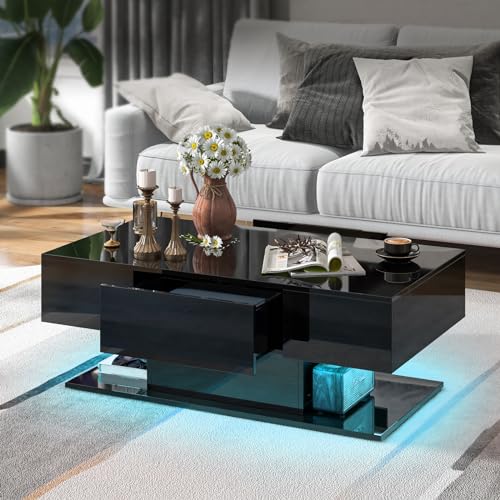
95 cm by 55 cm, a glossy White lacquered top with one large drawer and an open compartment underneath, plus LED lighting in twenty colours controlled by remote. At 31 cm, it stays very low, built for a living room where people sit on the floor. The high-gloss top, unlike a matt finish, shows every fingerprint as soon as it's touched.
110 cm by 60 cm, the deepest of the six, with large drawers and a low shelf on top of the twenty-colour LED lighting. At 40 cm, it easily takes a full family meal tray. Its generous depth, however, demands real clearance in front of the sofa, or the walkway becomes too narrow to move through comfortably.
85 cm by 50 cm, an adjustable lift-top that combines closed drawers with an open shelf for whatever doesn't stack flat easily. At 45 cm folded down, it sits at the top of the comfortable range for a typical seat height. The lift mechanism, handy day to day, remains one more mechanical part that can, over time, work slightly loose without regular upkeep.
One large drawer covers the basics: remote controls, chargers, a few magazines. Beyond that, two drawers already separate uses — one for electronics, one for everything else — with no need to rummage to find a specific item. Where drawers run out of room for bigger items, our lift-top table lineup opens up the whole volume under the top in one movement.
Four drawers, as on one of the models on this page, become useful mainly in a living room that also doubles as an office or a kids' play corner: each drawer keeps its own category, avoiding the catch-all drawer that always ends up overflowing.
The more drawers there are, the more runners there are to look after: excess weight in a single drawer can make it start to rub over time, without that being a real manufacturing fault.
Key point The more drawers there are, the more runners there are to look after: excess weight in a single drawer can make it start to rub over time, without that being a real manufacturing fault.
A lift-top: who's it for
A lift-top almost replaces a spare dining table: handy for a meal tray in front of a film, or for working on a laptop without bending down to the floor. The mechanism, mostly mechanical, needs both hands to operate — nothing automatic.
The trade-off of this feature: once raised, the top climbs noticeably higher than a standard coffee table, not always compatible with a sofa that has low armrests directly opposite. Measure the space available with the top raised, not just at rest.
For a living room that never doubles as a spare office, this feature stays a nice-to-have rather than a deciding factor: the fixed-drawer models on this page store just as well without the extra mechanism.
Key point For a living room that never doubles as a spare office, this feature stays a nice-to-have rather than a deciding factor: the fixed-drawer models on this page store just as well without the extra mechanism.
LED lighting: decorative above all
Several models on this page build LED lighting into the edge of the top, controlled by remote, sometimes with around twenty colours to choose from. The effect stays mainly decorative: it doesn't replace proper reading light, too diffuse and too low down for that.
This lighting uses little power, but it's still one more electronic component, with a cable to hide and a remote not to lose inside one of the drawers it lights up. If you never use this kind of mood lighting, a model without LEDs generally costs less for equivalent storage.
Key point If you never use this kind of mood lighting, a model without LEDs generally costs less for equivalent storage.
Depth and clearance in front of the sofa
A deep drawer holds more, but it also juts further into the room: beyond 55 cm of depth, check that the walkway between sofa and table stays within the usual 40 to 50 cm range.
The deepest models on this page suit a spacious living room best, where the sofa isn't pushed right up against the table. In a tighter space, a shallower model is the safer bet, even at the cost of a little storage capacity, rather than knocking into the table on every pass.
One last reference point: keep the top's height, once closed, under 45 cm to stay below a standard sofa seat, which sits between 45 and 60 cm.
Key point One last reference point: keep the top's height, once closed, under 45 cm to stay below a standard sofa seat, which sits between 45 and 60 cm.
Which wood or finish to choose
Light wood, as on the square model on this page, fits easily into a Scandinavian or Nordic interior, and hides dust better than a high-gloss lacquered top. White or black lacquer gives a sharper look, almost like a bathroom cabinet, but shows every fingerprint as soon as it's touched.
Neither finish is more fragile than the other day to day: the difference lies mainly in visible upkeep, not in the real strength of the panel underneath.
Key point Neither finish is more fragile than the other day to day: the difference lies mainly in visible upkeep, not in the real strength of the panel underneath.
The mechanism, a criterion before the looks
A simple drawer on standard runners stays the most reliable choice over the years: few moving parts, so little risk of jamming after several years of use. A lift-top or extending top adds real everyday comfort, but also one more mechanical part that needs to be handled with a bit of care.
Before choosing a model with a mechanism, ask yourself how often you'll actually use it. A lift-top used once a month justifies its cost less than a simple fixed drawer earning its keep every day.
On the six listings on this page, the length, depth and height are given for each model: check those figures before comparing the features against each other — measurements always come before the advertised function.
Key point On the six listings on this page, the length, depth and height are given for each model: check those figures before comparing the features against each other — measurements always come before the advertised function.
An empty drawer counts for less in the decision
Closed storage only makes sense if it matches a real need: counting the number of items you currently store on or under your existing coffee table gives a more reliable idea of how many drawers you need than simply wanting a well-equipped piece of furniture.
A drawer left empty is still a drawer that costs space and material without offering any real service. A single large, well-used drawer beats four half-empty ones that needlessly add weight to the piece.
Key point A single large, well-used drawer beats four half-empty ones that needlessly add weight to the piece.
We watch the tables on this page for you. One email when one of them drops, nothing else.
As an Amazon Associate, we earn from qualifying purchases. The product links on this page may earn us a commission if you buy something — at no extra cost to you. Prices shown may have changed since we last checked.
Written by the Tavolia Bassio team
We don't test the furniture: we record each piece's measurements one by one and say where our figures come from. When a dimension is missing from a listing, we say so instead of guessing. Our method.



 IDMarket, Table Basse carrée Talia 70
  VASAGLE Custos Collection, Table Basse
 COSTWAY Table Basse Laquée LED 20 Coul
 ZZINOKE Table Basse Relevable
 YITAHOME Table Basse Relevable Extensi
 LIFEZEAL Table Basse avec Éclairage LE