A lift-top table solves one single problem: eating or working without leaving the sofa, without dragging a proper table in from another room. Black, for its part, has the advantage of never clashing with the rest of the living room, whether it's pale or already dark. Six models bring both criteria together, with mechanisms that turn out to be far from equal once you compare them closely: a gas-lift strut, an asymmetric lift-top, or a hydraulic system don't offer the same travel, or the same everyday handling. Before ordering, look at how each table lifts, not just its colour or the price on the listing.
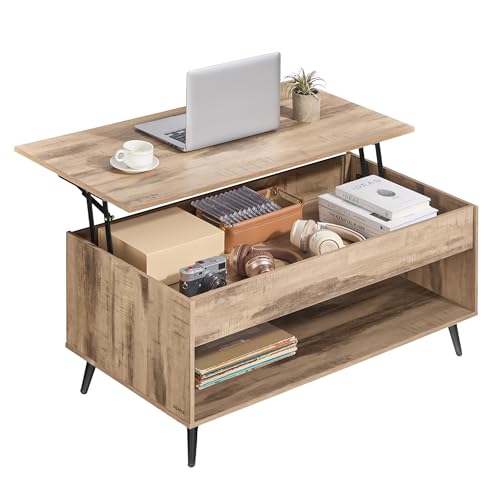
100 cm long by 45 cm once lowered, this Brown Camel + Black D'ink model rises on a gas-lift strut up to dining-table height, with a closed compartment under the top for remotes and magazines. The gas strut needs a firm push to engage properly: pushed too gently, the top drops back down on its own with no warning, which can catch you out the first time.
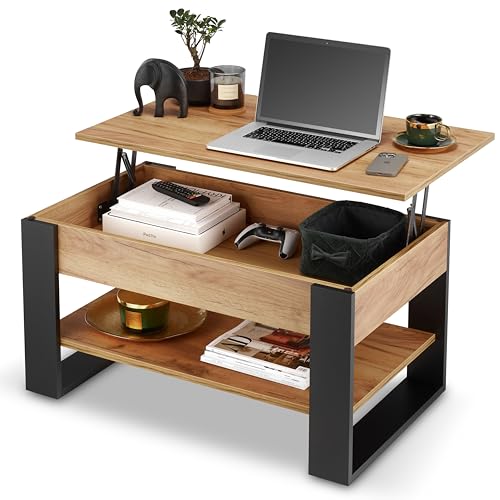
This Black + Oak model plays the card of a top that adjusts continuously between the low position and desk height, with none of the fixed stops of a standard gas-lift strut. Built from FSC-certified panels, it commits to an extra-large format rather than a compact table, made for a living room with room to spare. Its manual adjustment, unlike a gas strut, means supporting the top through the whole movement, which isn't always practical alone with your hands full.
60 cm by 60 cm, a lacquered Black top that rises by hydraulic mechanism from a low position of 45 cm, finished with an LED strip built into the edge. Storage comes in two drawers rather than an open compartment. The LED lighting, appealing in the evening, means an extra unit to plug in that non-LED models don't have, plus one more remote to find a home for.
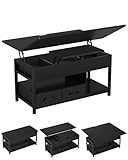
Folded down at 50 cm, this Black table measuring 100 cm by 50 cm unfolds into a proper work surface, made for working from home as much as for eating in front of a film. Two drawers round out the storage under the folded top. Once unfolded into desk position, it takes up noticeably more floor space than a standard lift-top table, not counting the room you need to leave clear to pull a chair back from it: measure the room before ordering.
At 100 cm long, 51 cm deep and 46 cm high, the only Black tempered-glass model in this selection, with a low shelf that doubles the available storage. The glass option changes the game against the five other wood or lacquered tops: the surface copes better with the heat of a cup set directly on it, but shows fingerprints faster than a matt top, and needs wiping down more often.
A gas-lift strut rises with one movement and drops back down on its own if you don't hold it firmly, handy for occasional use but less reassuring if a child is playing nearby and nudges the top by accident. A hydraulic mechanism adjusts continuously, with no fixed stops, and suits you better if you want a precise height for reading or working in front of the sofa. Since the mechanism matters more here than the colour, our full lift-top selection lets you compare gas and hydraulic systems side by side.
The asymmetric lift-top, found on just one model on this page, means clearing the rising side before you operate it: get into the habit of setting glasses down on the fixed side, or your first try ends in a small accident on the rug.
Either way, check the clearance between the raised table and your sofa: keep between 40 and 50 cm so you don't bang your knees once the table is up, especially on models that rise to full dining-table height.
The weight of the piece matters too: a sturdy mechanism often adds several kilos, which makes the table more stable once raised, but harder to slide from one corner of the room to another to clear space.
Key point The weight of the piece matters too: a sturdy mechanism often adds several kilos, which makes the table more stable once raised, but harder to slide from one corner of the room to another to clear space.
What the tabletop material changes
Lacquered wood and laminate dominate this selection: they cope better with the heat of a dish set directly on them than a glass top, but show scratches more from an object dragged across them carelessly. Panel finishes behave differently once a table also extends, so the extendable MDF coffee tables are worth comparing before you settle on a fixed lacquered top. Prefer visible grain to lacquer? The extendable wooden coffee tables hide scratches far better while still opening up when you need extra room. Storage aside, mobility often settles the choice: the industrial coffee tables on castors let you roll the whole piece away when the room needs to change shape. A neighbouring case is covered in black LED Coffee Table.
Tempered glass, found on just one model here, remains the easiest material to clean with a simple wipe, at the cost of more visible fingerprints day to day, especially under direct lighting that catches the light.
Black, common to all six tables, has the advantage of hiding small signs of wear better than white or pale wood — a real point in favour for a busy living room, with children or pets rubbing against the furniture.
Key point Black, common to all six tables, has the advantage of hiding small signs of wear better than white or pale wood — a real point in favour for a busy living room, with children or pets rubbing against the furniture.
Storage: the second thing to check after the mechanism
A lift-top table rarely just does eating: the compartment or drawers that often come with it also change day-to-day use. A closed compartment under the top, found on just one model on this page, hides its contents completely, unlike an open shelf that stays on show permanently. Should the frame matter more to you than the top, the extendable metal coffee tables pair a sturdier structure with a surface that grows for meals. Where black feels too severe against your walls, the grey LED coffee tables soften the effect and still light the middle of the room after dark.
Drawers, found on several models, keep things separated better than a plain open space, but need clearance in front of the table to open fully without catching the sofa or the legs of anyone sitting there.
A mechanism that unfolds the table into a proper work surface, as on one of the models here, also offers hidden storage under the fixed section: handy, but less immediate than a drawer you open in one go with nothing to unfold first.
Before choosing, list what you'll actually store under the table: remotes and magazines are happy with a simple compartment, while work files are better suited to a proper drawer that locks if needed.
The LED strip, found on two models on this page, doesn't help with storage but changes the mood of the room in the evening: a real plus for some, one more gadget to power and maintain for others. Also check the stated warranty on the lifting mechanism, the part that wears out first on a lift-top table, well before the top or the drawers. That detail, more than the black colour shared by all six tables, will make the difference after a few years of everyday use, long after the initial novelty has worn off.
Key point That detail, more than the black colour shared by all six tables, will make the difference after a few years of everyday use, long after the initial novelty has worn off.
Price alert
Tell me when the price drops
We watch the tables on this page for you. One email when one of them drops, nothing else.
As an Amazon Associate, we earn from qualifying purchases. The product links on this page may earn us a commission if you buy something — at no extra cost to you. Prices shown may have changed since we last checked.
Written by the Tavolia Bassio team
We don't test the furniture: we record each piece's measurements one by one and say where our figures come from. When a dimension is missing from a listing, we say so instead of guessing. Our method.




 VEVOR Table Basse en Verre Trempé
 defiPad Table Basse Relevable avec Ran