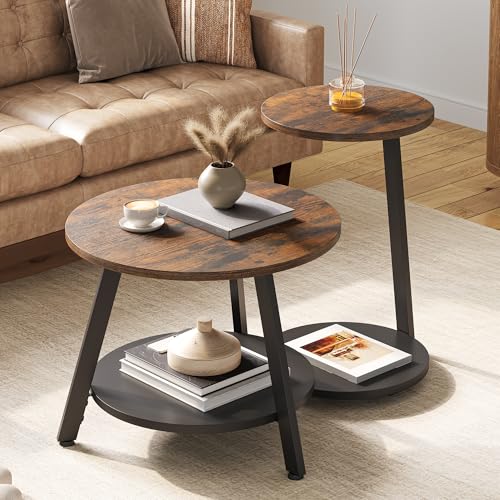
Under this size a piece stops being a centrepiece, but its surface can still impress, and this veined, stone-like top proves it. The two-thirds sofa rule barely applies at this small size: this format exists mainly to fit where a standard table simply won't.
The trade-off to accept from the start: less surface inevitably means fewer things you can set down at once. A cup and a book fit without any trouble, a full meal tray for two quickly becomes tight, or downright impossible. It's the logical price to pay for fitting into a genuinely small space.
Even so, keep at least 40cm of clearance if the table sits close to a sofa or a busy walkway in the room, and don't exceed the sofa's seat height, generally between 45 and 60cm.
A student studio, a teenager's bedroom, or simply an extra piece in a large, already-furnished living room: this small size answers very specific needs rather than an everyday, general-purpose use. For even smaller options than this, our small coffee table picks cover the tightest spaces of all.
vidaXL Table Basse Vieux Bois 102x55x42 cm Bois d'ingénierie
102 x 55 x 42 cm · Old Wood
102 cm by 55 cm, a top in an aged-wood effect made from engineered wood, a material chosen here for its stability against ambient humidity rather than for the raw look of traditional solid wood. At 42 cm, it stays discreet in a corner of the room without catching the eye. Engineered wood mimics the grain of natural wood well to look at, but remains a factory-made composite panel: less resistant than a genuine solid piece to a hard knock on a corner of the top.
HOMCOM Table Basse Coulissante avec Plateau Coulissant 110x52x36 cm Bl
110L x 52l x 36H cm · White
110 cm by 52 cm, a white sliding top that turns into an ergonomic desk with one simple move, with a hidden compartment for storing the essentials out of visitors' sight. At 36 cm high, it fits under most armrests without catching. The sliding mechanism, handy day to day for working, remains one more moving part in the structure: without regular upkeep, it ends up catching slightly over the years, as any mechanical rolling rail does.
IDMarket, Table Basse Ronde Nova 70 cm Bois Effet travertin
70x70x35 · Travertine
A round table 70 cm across, in a travertine effect over the whole surface, mounted on slim, pale wooden legs. At 35 cm high, it suits a reading corner or an end-of-sofa spot more than the centre of a large, spacious living room. The travertine effect stays a worked surface finish: underneath the visible coating, the top keeps the weight and fragility of a much more ordinary composite material.
A set of two round nesting tables, the larger one measuring 61 cm across and 38 cm high, with a lower shelf for keeping the essentials within reach without bending too low. Designed for a compact, well-planned space. The pair gains in flexibility what it loses in usable surface per table: without a genuinely wide top, each one stays suited to one object at a time, not to a busier, more varied use.
WOHNLING Basse Design Gris Ciment/Blanc | Table de Salon avec 2 tiroir
70 x 36,5 x 70 cm · Grey
70 cm wide by 70 cm, mounted on discreet castors, with two drawers for storing magazines and small items out of guests' sight. At 36.5 cm high, it stays low and easy to push from one corner to another. The castors make everyday moving easier but leave the table less stable than a fixed leg if someone leans on it suddenly, especially on a smooth floor like varnished parquet or polished tiles.
Delivered as a single piece, with not a single bolt to tighten, this table measures 108 cm by 50 cm in completely clear tempered glass. At 35 cm high, it fades visually into a small space that's already full, almost invisible once set down on the floor. The flip side of this total transparency: there's no hiding anything in it, whatever's left underneath stays permanently on show to your guests.
A supporting role, not the centrepiece of the room
Under 60cm, the coffee table stops being the visual anchor of the room and becomes a secondary surface instead: an end-of-sofa spot, a reading corner, an improvised bedside table next to a comfortable armchair. That's not a flaw in the format itself, just a different use from a standard coffee table set in front of a large family sofa.
If you're after a surface for a full meal or a loaded tray, this size stays too tight for that particular use: it's better to look at the bracket above, starting from 60cm long.
Small tables trade surface area for a lighter footprint, and the circular storage collection keeps that scale while adding hidden space.
Key point Small tables trade surface area for a lighter footprint, and the circular storage collection keeps that scale while adding hidden space.
Nesting or a single table at this small size
Two small nesting tables multiply the possible uses without multiplying the floor space taken up: they split apart to have people round, come back together for everyday rest. A single table stays more stable for something a bit heavy, a laptop left out for a long time, say. Should a single stable top win out, our pick of the best mid-size coffee tables covers models sturdy enough for daily laptop use.
At this small size, the difference in stability between nesting and single tables is felt more than elsewhere in the range: each nesting top is necessarily smaller and thinner than a single top of the same total footprint.
Key point At this small size.
Castors or fixed legs: a real choice under this size
Castors really earn their keep on a small table of this format: easy to push from one corner of a tight studio to another, or to shift quickly to clear the way for a moment. The logical trade-off remains stability, lower than a fixed leg if someone leans on it to get up from the sofa without thinking. When the studio gives way to something larger, the guide to coffee tables for a larger living room rethinks the size question entirely.
In a studio where the table often changes spot over the week, castors are well worth the trade-off; in a living room where it stays put permanently, an ordinary leg is enough and generally costs less to buy.
Key point In a studio where the table often changes spot over the week, castors are well worth the trade-off; in a living room where it stays put permanently, an ordinary leg is enough and generally costs less to buy.
Material: a decisive factor at this small scale
On a small top, every flaw in the material stands out more than on a large table where the eye spreads across the whole available surface. A well-chosen composite or reconstituted panel holds up well for light use, a cup and a book set down day to day without excess.
Keep solid wood or natural stone for heavier use, if the small table also serves as an occasional step or regularly takes heavy objects.
Key point Keep solid wood or natural stone for heavier use, if the small table also serves as an occasional step or regularly takes heavy objects.
Studio or teenager's bedroom: two very different uses
In a studio, the small coffee table often also doubles as a spare desk or a support for a full meal tray; in that case it's better to favour a flat, stable top rather than a shaped one that reduces the available flat surface.
In a teenager's bedroom, it serves more as an occasional support for a laptop or a games console: stability then matters more than style, especially if the table often changes spot as the room gets rearranged.
Key point In a teenager's bedroom, it serves more as an occasional support for a laptop or a games console: stability then matters more than style, especially if the table often changes spot as the room gets rearranged.
The relationship between a small table and a larger storage piece
A small coffee table pairs well with a more substantial storage piece elsewhere in the room: a bookcase, a sideboard or a wall shelf take over for everything the small table can't hold on its own.
Without that back-up, the lack of surface shows quickly: things piling up, a top that's always cluttered, a sign the room is missing a proper storage piece.
Key point Without that back-up, the lack of surface shows quickly: things piling up, a top that's always cluttered, a sign the room is missing a proper storage piece.
Where to place a small table in a living space
A small table naturally finds its place against a sofa armrest, next to a standalone armchair, or in a free corner near a window where it supports a lamp as much as a cup.
Avoid centring it alone in the middle of a large living room: its small size gets visually lost there, it does a far better job in a supporting position, alongside another, more substantial piece.
Key point Avoid centring it alone in the middle of a large living room: its small size gets visually lost there, it does a far better job in a supporting position, alongside another, more substantial piece.
What people often forget to check before buying this small
The maximum weight the top can take is rarely made prominent on the product listing, even though it varies a lot from one small model to another: a laptop left out for a long time needs more sturdiness than a simple cup of tea.
Also check the exact depth if the table needs to fit into a precise gap between two pieces of furniture: on such a compact format, a difference of a few centimetres changes everything when it comes to fitting it in.
Key point Also check the exact depth if the table needs to fit into a precise gap between two pieces of furniture: on such a compact format, a difference of a few centimetres changes everything when it comes to fitting it in.
The pairing of small table and large armchair
Next to a standalone armchair, a small coffee table does a very specific job: holding a book, a cup or a remote within reach without eating into the walking space around the armchair itself.
In that case, choose a height close to the armchair's armrest rather than the sofa's seat: the two references don't always match, depending on the furniture already in the room.
Key point In that case, choose a height close to the armchair's armrest rather than the sofa's seat: the two references don't always match, depending on the furniture already in the room.
This size on a balcony or in a conservatory
In a sheltered outdoor spot, under a conservatory roof or on a covered balcony, a small coffee table gets more occasional use than indoors: sturdiness against damp then matters more than the most polished finish.
Even so, check that the material can handle the temperature swings of an unheated room, a point that listings aimed at indoor use don't always spell out.
Key point Even so, check that the material can handle the temperature swings of an unheated room, a point that listings aimed at indoor use don't always spell out.
The final call between the six models featured
Under 60cm, always keep in mind that you're choosing a supporting piece, not the centrepiece of the living room: a small table that earns its keep every day beats a larger model that ends up getting in the way more than it helps.
Start from the exact use you have in mind, morning coffee, evening reading or a meal-tray support, rather than the look of the photos alone, before deciding.
Key point Start from the exact use you have in mind, morning coffee, evening reading or a meal-tray support, rather than the look of the photos alone, before deciding.
This size and the living room's connected devices
A small coffee table often serves as a base for a smart speaker or a wireless charger: in that case, check that a cable can run discreetly to a nearby socket, without trailing across the whole room in full view.
A model with a small open compartment makes this kind of use easier, hiding the power adapter without getting in the way of quick access to the device sitting on top.
Key point A model with a small open compartment makes this kind of use easier, hiding the power adapter without getting in the way of quick access to the device sitting on top.
One last pointer before ordering under this size
Under 60cm, it's better to measure twice rather than once: the exact spot planned for it in the room, and the space genuinely available around it once the piece is actually in place, not just pictured on a plan.
Key point Under 60cm, it's better to measure twice rather than once: the exact spot planned for it in the room, and the space genuinely available around it once the piece is actually in place, not just pictured on a plan.
Worth knowing
Frequently asked questions
Is a table under 60cm enough for a meal in front of the TV?
For one person and a simple dish, yes; for a full meal tray for two, the surface quickly gets tight, and a format from 60cm up stays more comfortable day to day.
Is engineered wood as good as solid wood?
It's more stable against humidity than poorly treated solid wood, but stays less resistant to a hard knock on a corner than a solid piece of equivalent thickness.
Do you need castors on a small coffee table?
Useful if it often changes spot, in a studio for example; on a table that stays put in a living room, an ordinary leg is enough and stays more stable day to day.
Price alert
Tell me when the price drops
We watch the tables on this page for you. One email when one of them drops, nothing else.
As an Amazon Associate, we earn from qualifying purchases. The product links on this page may earn us a commission if you buy something — at no extra cost to you. Prices shown may have changed since we last checked.
Written by the Tavolia Bassio team
We don't test the furniture: we record each piece's measurements one by one and say where our figures come from. When a dimension is missing from a listing, we say so instead of guessing. Our method.


 vidaXL Table Basse Vieux Bois 102x55x4
 WOHNLING Basse Design Gris Ciment/Blan
 GOPLUS Table Basse Verre Trempé